
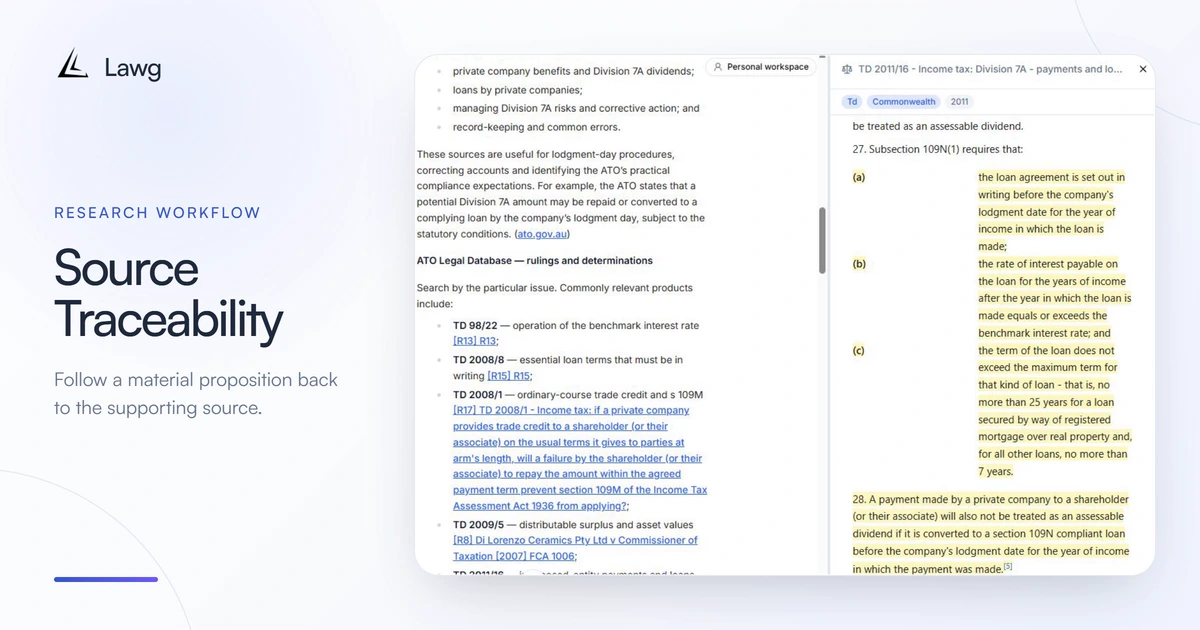
Source traceability is the ability to move from a statement in an AI-assisted research answer back to the material used to support it. In tax research, that means a reviewer can identify and inspect the relevant legislation, ruling, guidance, or judgment rather than relying on fluent prose alone.
Traceability does not make an answer correct. It makes the answer more inspectable and gives the practitioner a practical starting point for verification.
Why fluent answers can still be difficult to review
An AI-generated explanation may sound confident while leaving basic questions unanswered:
- Which authority supports the statement?
- Does the source say what the answer claims it says?
- Is the material current?
- Does it address the relevant jurisdiction and period?
- Has the answer introduced an assumption that was not in the question?
Without a usable path back to the source, a reviewer may need to repeat much of the search before deciding whether the answer is useful. A source marker adds value only when it leads to material that can be inspected.
What source traceability looks like in practice
A reviewable research workflow connects three layers:
- The proposition. The answer makes a specific statement that matters to the analysis.
- The source reference. A marker identifies the legislation, ruling, guidance, or decision associated with that statement.
- The underlying passage. The reviewer opens the source and reads the relevant text in context.
The final step matters most. A document title by itself does not show that the cited material supports the proposition. The surrounding text may contain definitions, exceptions, dates, or qualifications that change how the passage should be understood.
What a citation can and cannot establish
| A citation can help a reviewer | A citation cannot establish by itself |
|---|---|
| Locate the source associated with a proposition | That the proposition is correct |
| Inspect the relevant passage in context | That the source is current or controlling |
| Identify which material informed the answer | That no relevant authority is missing |
| Record part of the research path | That the source applies to the user's facts |
| Challenge or refine an unsupported statement | That professional judgement is no longer needed |
Citation presence is evidence about traceability, not a quality score for the final answer.
A five-step source review
One practical editorial sequence for inspecting an AI-assisted answer is:
- Identify the material propositions. Start with statements that would change the analysis or the next research step.
- Open the linked source. Confirm that the marker resolves to the stated document and read beyond an isolated sentence.
- Check support. Decide whether the passage supports the proposition as written or only part of it.
- Check currency and context. Review the source's date, status, period, and jurisdiction.
- Record uncertainty. Preserve gaps or conflicts instead of converting them into a confident conclusion.
How Lawg presents a research trail
Lawg's Australian tax engine draws on Australian legislation, ATO materials and selected decisions. Its public methodology explains the source collections and official-source research approach.
Where an answer includes source references, open the available material alongside your research. Read the passage in context and follow the original-source link when you need to investigate further. Exact-passage highlighting depends on whether the passage can be located in the source.
These features support inspection. They do not guarantee completeness, currency, or correctness, and they do not replace the reviewer's assessment of the source or its application.
A simple example of the workflow
Suppose an answer includes three material propositions marked [R1], [R2], and [R3]. The reviewer opens [R1] and finds direct support. [R2] links to the right document but the passage contains a qualification missing from the answer, so the proposition is narrowed. [R3] does not provide sufficient support, so the reviewer continues researching.
The useful outcome is not that the answer had three citations. It is that the research trail helped the reviewer confirm one point, correct another, and identify a gap.
Frequently asked questions
Does source-cited mean correct?
No. A citation can show where supporting material may be found, but the reviewer still needs to confirm that the source supports the statement, remains current, and is relevant to the question.
Why open the original source?
Definitions, exceptions, dates, and surrounding paragraphs can change the meaning of an isolated passage. Opening the source lets the reviewer inspect that context directly.
Can a citation show that research is complete?
No. A citation shows a connection to a source; it does not show that every relevant source was found or that later material does not affect the analysis.
How does Lawg display sources?
Depending on the answer and available evidence, Lawg may display references and source cards. Open the source to inspect its context and use the original-source link for further reading.
Does Lawg replace practitioner review?
No. Lawg is an Australian tax engine supporting research and work for the client file. Its citation workflow is intended to make source inspection more direct, while the practitioner remains responsible for evaluating the material and the work that follows.
Methodology: Read How Lawg Grounds Australian Tax Research for the current explanation of source collections, references and source review.
This article describes a research workflow and product methodology. It is general information only and is not tax, legal, or financial advice. A citation is a review aid, not proof that a proposition is correct, current, complete, or applicable.