

What Australian Tax Professionals Should Look for in an AI Tax Research Platform

Australian tax professionals increasingly need more than a broad legal research database. The practical workflow starts with understanding the client facts, identifying the relevant tax issues, locating authoritative Australian sources, and turning the analysis into advice that can be reviewed and communicated clearly.
Broad legal research platforms may remain valuable where firms require extensive legal content. However, accountants and tax practitioners may also benefit from specialised AI platforms designed around Australian tax advisory workflows.
The right platform should not simply generate a polished answer. It should help practitioners investigate the issue, identify related obligations, verify the underlying authority, and prepare a review-ready draft without removing professional judgement from the process.
Quick summary
When evaluating an AI tax research platform, Australian accounting firms should prioritise:
-
Australian legislation, ATO materials and case law;
-
transparent and verifiable citations;
-
tax-specific issue spotting;
-
drafting support for memos, file notes and client communications;
-
clear handling of assumptions and missing facts;
-
controls that support practitioner review;
-
appropriate privacy, security and data-handling arrangements.
The quality of the generated prose matters, but it is secondary to the accuracy, relevance and traceability of the supporting sources.
Why tax teams may need a more specialised workflow
A tax practitioner rarely needs only a list of search results.
A client may begin with a question about a shareholder loan, trust distribution, property transaction or business sale. That initial question can lead to connected issues involving Division 7A, section 100A, GST, CGT, PSI, residency or anti-avoidance provisions.
The full workflow may involve:
-
identifying the primary tax issue;
-
recognising related obligations and integrity rules;
-
locating the relevant legislation and ATO guidance;
-
reviewing applicable judicial authority;
-
identifying missing or uncertain client facts;
-
preparing a technical analysis;
-
converting the analysis into a memo, file note or client explanation;
-
reviewing the underlying sources before the advice is issued.
A general legal research platform may provide valuable source material, but a tax-focused platform should also help practitioners move through these connected stages efficiently.

Core capabilities to evaluate
Australian source coverage
Ask the vendor which Australian materials are included and how those materials are maintained.
Relevant sources may include:
-
Commonwealth tax legislation;
-
ATO rulings and determinations;
-
practical compliance guidelines;
-
ATO administrative and interpretative guidance;
-
explanatory memoranda;
-
Federal Court, Full Federal Court, High Court and tribunal decisions;
-
relevant state and territory materials where the platform claims to cover them.
Do not rely on a broad statement that the platform covers “Australian tax law”. Ask which source collections are available, how frequently they are updated and whether users can inspect the original material.
Citation transparency
A citation should do more than display the title of an Act, ruling or case.
The practitioner should be able to:
-
identify which proposition the citation supports;
-
open the underlying source;
-
locate the relevant section, page or passage;
-
determine whether the source is current;
-
distinguish primary authority from secondary explanation;
-
assess whether the authority applies to the client’s facts.
During a demonstration, select one material conclusion and trace it back to the cited authority. If the source does not support the proposition, the quality of the generated writing is irrelevant.
Tax-specific issue spotting
Tax matters rarely sit within one isolated provision.
For example, a query about the disposal of a business asset may also raise questions about:
-
the small business CGT concessions;
-
the active asset test;
-
significant individual requirements;
-
GST treatment;
-
Division 7A consequences;
-
trust distributions;
-
restructuring provisions;
-
anti-avoidance rules.
A useful platform should help practitioners identify adjacent issues without suggesting that every issue automatically applies.
The value lies in prompting further investigation. The practitioner still needs to determine which issues are relevant to the client’s facts.
Drafting support
Research and drafting should not operate as disconnected tasks.
Once the practitioner has completed the analysis, the platform should help organise it into an appropriate professional format, such as:
-
a technical research summary;
-
a formal advice memo;
-
a client letter;
-
a file note;
-
a meeting preparation brief.
The relationship between the analysis and its supporting sources should remain visible when the output format changes.
Practitioner control
AI-generated tax analysis should remain subject to professional review.
Firms should consider whether the platform supports a clear process for:
-
reviewing client facts and assumptions;
-
checking the relevant authorities;
-
identifying missing information;
-
correcting unsupported conclusions;
-
approving the final output before it is shared externally.
The platform should assist professional judgement, not obscure or replace it.
How Lawg supports Australian tax advisory work
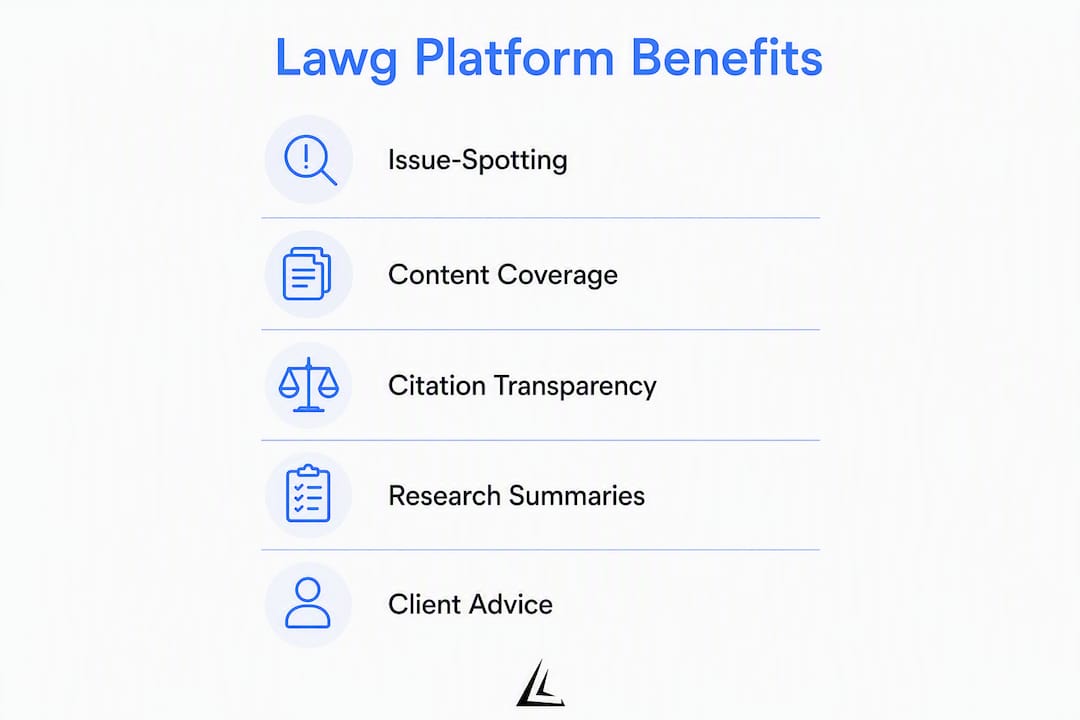
Lawg is an AI tax research and advisory platform built for Australian accountants and tax practitioners.
It brings research, related-issue identification and advice drafting into one connected workflow. Practitioners can investigate a tax issue, review the supporting Australian sources and organise the analysis into different professional formats.
Source-backed research
Lawg researches Australian legislation, ATO materials and case law and provides inline references within its outputs.
This allows practitioners to inspect the supporting authority rather than rely solely on the generated conclusion.
Related-issue identification
A client question may involve more than the issue originally raised.
Lawg helps surface related tax considerations that may require further investigation. These prompts are intended to broaden issue identification, while the practitioner remains responsible for determining which matters are relevant.
Professional drafting formats
The same underlying analysis can be organised into formats such as:
-
a research summary;
-
an advice memo;
-
a client-facing explanation;
-
a file note.
This can reduce repetitive drafting while preserving the connection between the analysis and its supporting sources.
Consultation preparation
Lawg can also assist practitioners in preparing for client discussions by organising:
-
the principal tax issues;
-
relevant sources;
-
assumptions;
-
missing information;
-
questions that require clarification.
The objective is not to automate the professional relationship. It is to help the practitioner enter the discussion with a more structured understanding of the matter.
Questions to ask during a vendor demonstration
Use a realistic but anonymised client scenario rather than relying solely on the vendor’s prepared example.
Ask the vendor to demonstrate the following:
-
Which Australian sources are being searched?
-
Can each material conclusion be traced to an underlying source?
-
Does the cited source actually support the proposition?
-
How does the platform deal with incomplete or ambiguous facts?
-
Does it identify related issues without overstating their relevance?
-
Can the analysis be converted into different professional formats?
-
What happens when legislation, ATO guidance or case law changes?
-
How are client queries and uploaded documents handled?
-
Where is data processed and stored?
-
What review controls are available before an output is shared externally?
A strong demonstration should make it easy to examine the platform’s limitations as well as its capabilities.
A practical pilot approach
Before adopting an AI tax research platform across a firm, run a controlled pilot using representative matters.
Select a small group of users with different levels of experience and test the platform against scenarios the firm already understands.
Useful measures include:
-
time from the initial query to the first usable draft;
-
practitioner time spent reviewing sources;
-
the proportion of citations that support the relevant proposition;
-
the number of material issues missed or incorrectly raised;
-
the amount of editing required before external use;
-
user adoption during the pilot;
-
turnaround time for client advice.
The purpose of the pilot is not to prove that the platform can generate attractive text.
It is to determine whether the platform reduces total research and review time while maintaining an acceptable professional standard.
Common risks and practical controls
AI-assisted tax research can improve efficiency, but firms should address the associated risks deliberately.
Unsupported conclusions
A model may produce a plausible conclusion that is not supported by the cited authority.
Practical control: Require reviewers to inspect the material citations supporting the central conclusion.
Incomplete source coverage
A relevant ruling, decision or legislative amendment may not be available within the platform.
Practical control: Understand the product’s source coverage and use additional research methods where the matter requires them.
Over-reliance on generated output
Users may accept an answer because it is clearly written and professionally formatted.
Practical control: Treat generated analysis as a research aid and draft, not as a final professional opinion.
Incomplete client facts
Tax conclusions often change when a factual assumption changes.
Practical control: Require the analysis to identify assumptions, missing information and factual dependencies.
Confidentiality and data handling
Client queries may contain sensitive or identifying information.
Practical control: Review the vendor’s privacy policy, security documentation and data-processing terms before submitting client information. Use anonymised scenarios during initial testing.
Inadequate engagement records
The firm may later need to understand how an advice position was reached.
Practical control: Retain the relevant research, source materials, assumptions, draft advice and practitioner review as part of the engagement file.
The practitioner approving the advice remains responsible for its accuracy and appropriateness, regardless of which tools assisted in preparing it.
Why citation quality matters more than polished prose
AI platforms can produce well-structured and confident writing within seconds. That capability is useful, but it can also create false confidence.
A polished memo supported by an irrelevant or misunderstood authority may be more dangerous than a rough draft that clearly exposes gaps in the analysis.
The rough draft invites review. The polished but unsupported answer may pass through the workflow without sufficient challenge.
For that reason, firms should establish their citation and review standards before using AI-generated work on live client matters.
A practical review should ask:
-
Does the source support the specific proposition?
-
Is the provision, ruling or decision current?
-
Are relevant exceptions or qualifications missing?
-
Do the client facts satisfy the required statutory conditions?
-
Has the platform confused commentary with primary authority?
-
What additional research would a prudent practitioner perform?
Generative quality matters, but it should remain downstream of reliable research and professional verification.
Test Lawg with a realistic tax scenario
The most effective way to evaluate Lawg is to test it against a realistic matter and inspect both the answer and its supporting sources.
Suitable scenarios include:
-
a Division 7A shareholder loan involving minimum yearly repayments and potential deemed dividend consequences;
-
a trust distribution that may raise section 100A considerations;
-
a small business CGT concessions matter involving the active asset and significant individual requirements;
-
a property transaction involving GST and new residential premises;
-
an individual residency scenario involving an extended overseas assignment.
For each scenario, assess:
-
whether Lawg identifies the main and related issues;
-
whether the cited authorities support the analysis;
-
whether important factual assumptions are stated;
-
how much practitioner editing is required;
-
whether the resulting draft improves the firm’s overall turnaround time.
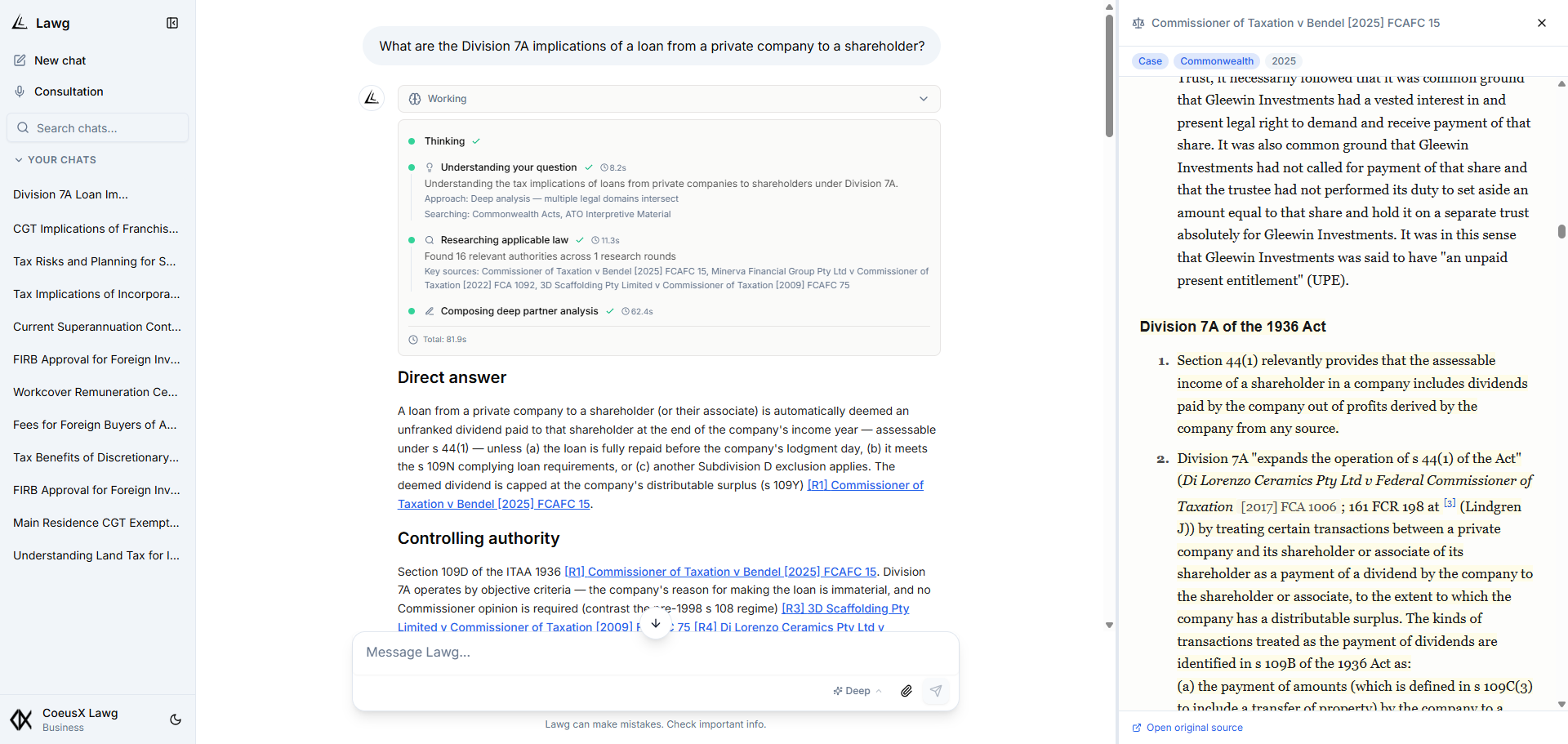
Lawg is designed to help Australian tax professionals move from technical research to review-ready advice within one connected workflow.
Try Lawg with a real tax scenario
AI-assisted content and research should be independently reviewed by a qualified professional. This article is general information and does not constitute tax or legal advice.