

Australian tax practitioners do not need another search engine. They need a workflow that helps them research authorities, identify issues, and prepare advice.
That is what this release is about.
1. Research That Starts With the Source
Lawg answers tax questions using Australian legislation, ATO rulings, and case law, not training data, not secondary commentary. Every substantive claim carries an inline citation you can click to open the original source and verify the reasoning yourself.
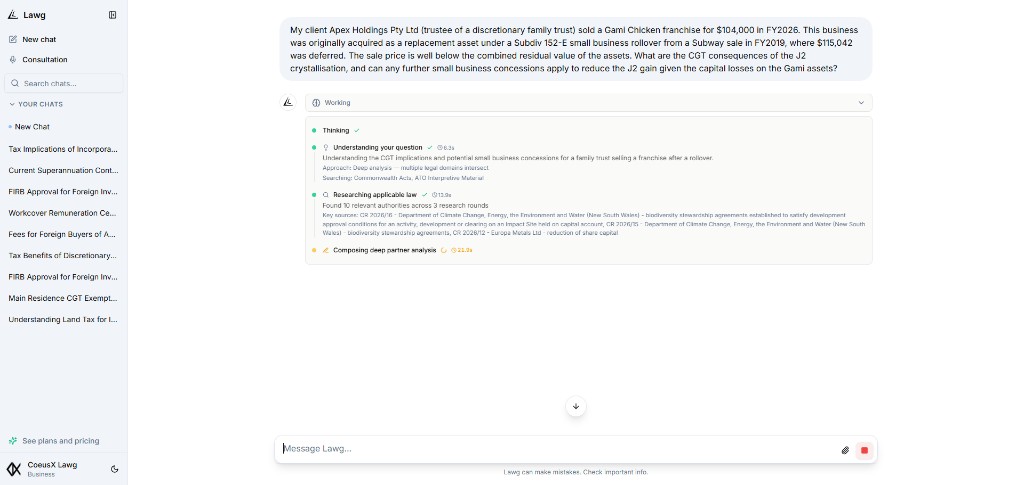
Ask about Division 7A loan arrangements, and the answer cites the specific ITAA 1997 provisions and the relevant Tax Ruling paragraphs. Ask about CGT small business concessions, and you get Division 152 with the $6M net asset value test, the active asset test, and the leading case law, not a generic overview.
Lawg draws on a corpus of hundreds of thousands of Australian legal authorities: federal and state legislation, ATO rulings and guidance across all major series (TR, TD, LCR, GSTR, PCG, and more), and case law from the Federal Court, High Court, and state courts. Ask in plain language. Get a citation-backed answer in seconds.
2. Issue Spotting: Not Just Answering the Question You Asked
This is the capability that most clearly separates Lawg from other AI tools.
When a client says "I run an IT consulting business as a sole trader. Most revenue comes from one client. I plan to sell the business within two years", most tools answer the CGT question. A well-trained practitioner sees more:
| Issue | Why it is triggered |
|---|---|
| Personal Services Income | "Most revenue from one client" (the 80% rule) |
| Contractor vs employee | Single-client concentration raises workforce classification risk |
| CGT small business concessions | Division 152 (net asset value test, active asset test) |
| CGT discount eligibility | Two-year ownership timeline |
| GST implications | Sole trader turnover thresholds, enterprise cessation |
| Business structure | Sole trader may not be optimal for a planned sale |
Lawg identifies these adjacent issues automatically, based on the fact pattern, not based on keywords. The system maintains a structured taxonomy of Australian tax issues and detects which ones your client situation activates, including the ones they did not mention.
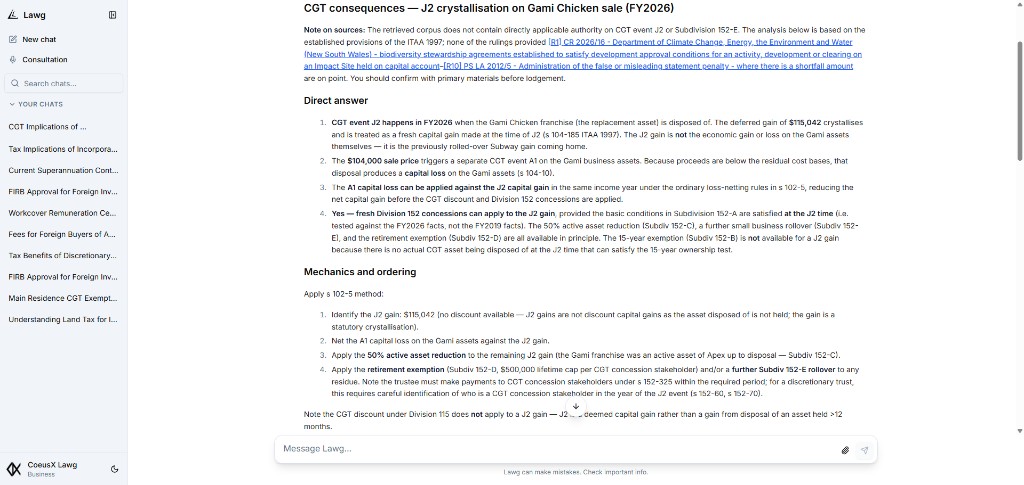
The result is not a longer answer. It is better issue coverage.
This matters because missing an adjacent issue (PSI on a business sale, Div 7A on a trust distribution, s100A on a family arrangement) is the kind of oversight that creates real professional risk. Lawg helps practitioners catch what they might not have thought to look for.
3. From Research to Professional Work Product
Tax research is only useful if it becomes a document. Lawg now generates three types of professional output directly from your research:
Tax Advice Memo. Structured internal analysis covering issues identified, relevant facts and assumptions, applicable law, analysis, conclusion, and caveats. The format follows the structure used by major accounting firms: clear section headings, authority citations, and risk assessment.
Client Letter. Client-facing correspondence in plain English: background, advice, the reasoning behind the advice, practical implications, recommended next steps, and appropriate qualifications. Formatted with letterhead placeholders for your firm details, ready to review and send.
File Note. Internal workpaper documentation: facts received, assumptions made, issue considered, position taken, basis for position, risks and caveats, and action items. The audit trail that every well-run practice maintains.
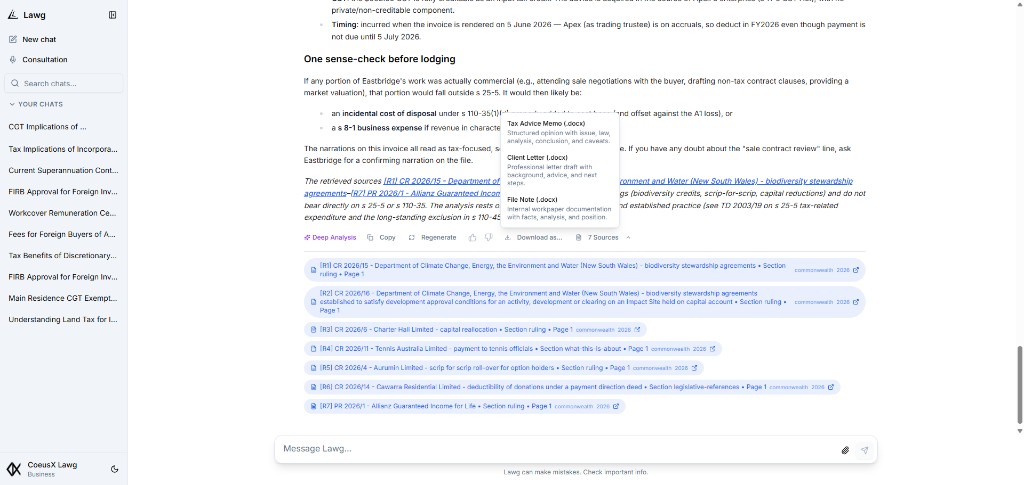
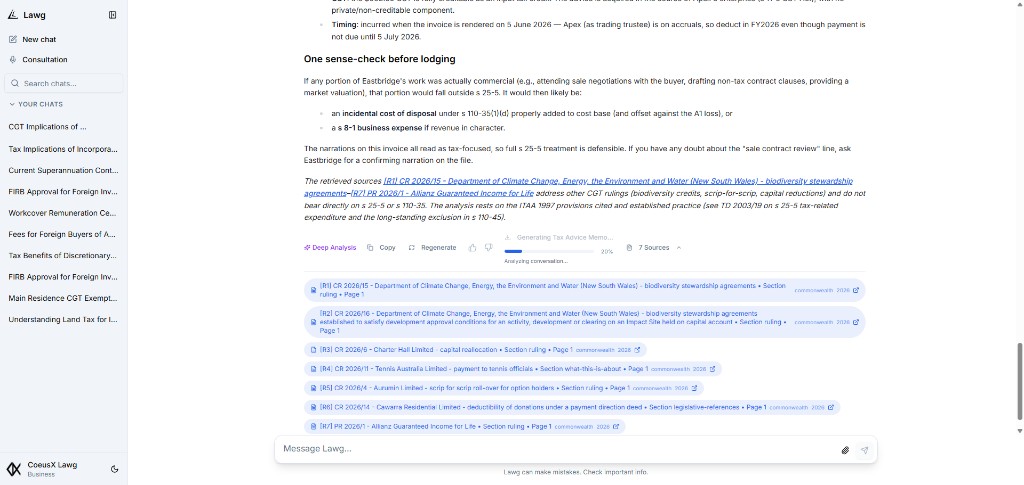
Each document is exported as a Word file with A4 formatting, professional typography, and a clear AI-generated draft disclaimer. One research session can produce all three: the internal memo, the client letter, and the file note, without rewriting the analysis from scratch.
4. Click Any Citation. See the Source.
Every claim in a Lawg answer is linked to its source. Click a citation and the original legislation section, ATO ruling paragraph, or case law passage opens in a side panel with the exact text highlighted.
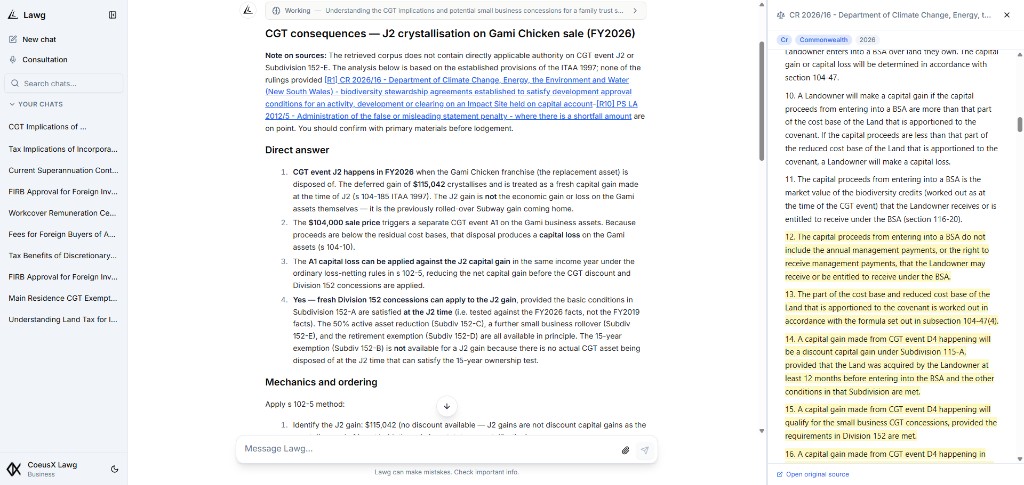
This is not a link to a document. It is a link to the specific passage that supports the claim. The passage is highlighted and scrolled into view, so you can verify the reasoning without searching through the source manually.
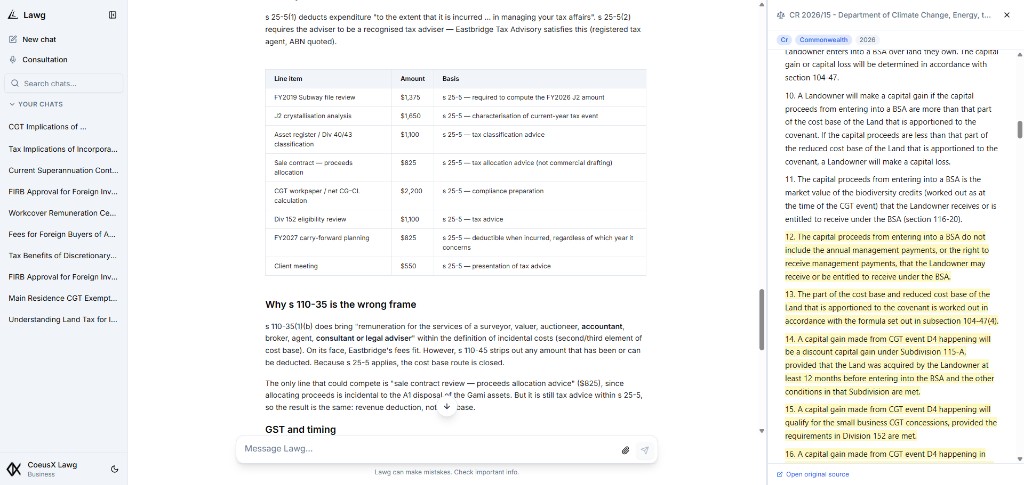
When the source text differs slightly from the stored version (paragraph numbering, formatting characters, typographic variations across different legal databases), Lawg uses multiple matching strategies to locate the correct passage reliably. High-confidence matches get a strong highlight; lower-confidence matches get a softer indicator so you know the match is approximate rather than exact.
For practitioners who need to verify every claim before relying on it, this is the difference between a useful research tool and one you can actually trust.
5. Upload Documents, Then Ask Questions
Drop an invoice, receipt, contract, bank statement, or spreadsheet into the chat. Lawg analyses it, extracting vendor details, ABN, line items, GST amounts, and totals, then lets you ask follow-up questions in the same conversation.
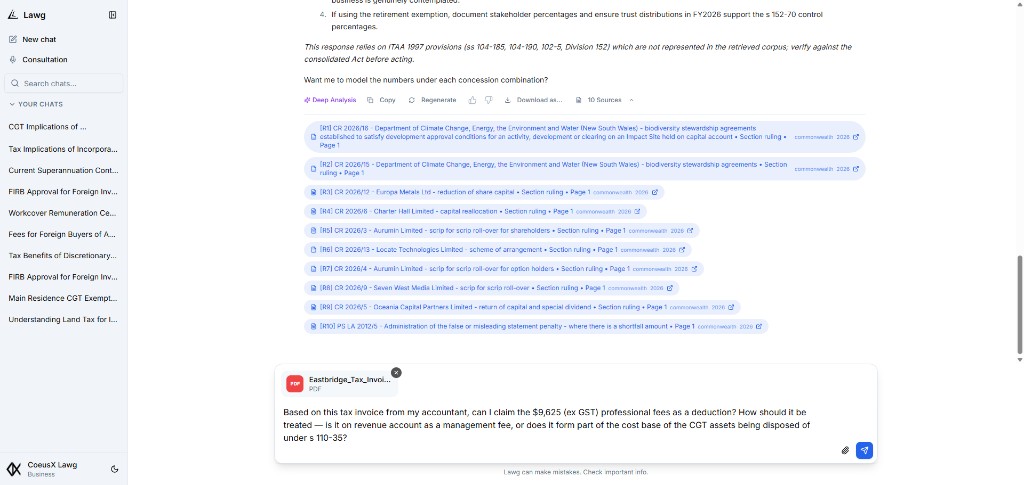
"Is this invoice GST-claimable?"
"What expense category should this be?"
"Are there any compliance issues with this receipt?"
Supported formats include PDF, Word, Excel, CSV, and images. Essentially every document type that lands on an accountant desk.
6. Platform Reliability
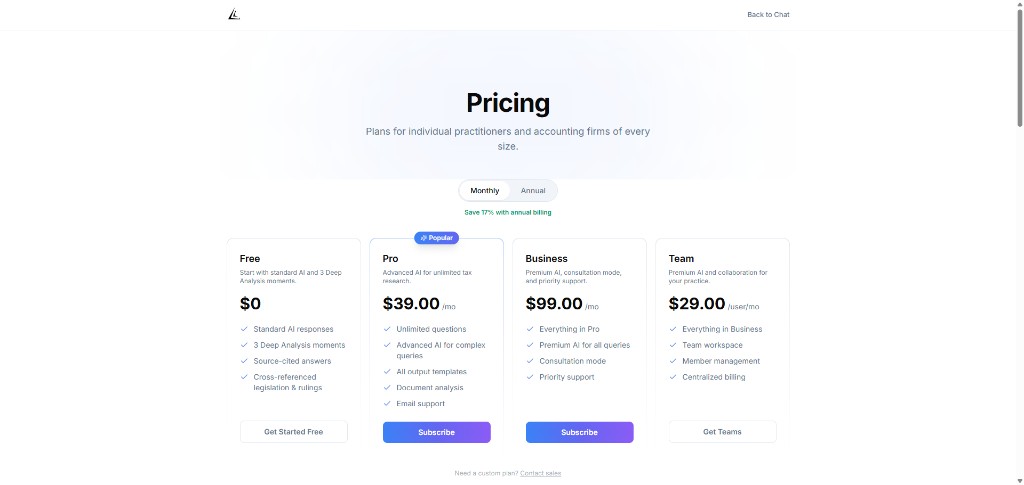
Each plan includes a daily credit budget for premium-quality analysis. When credits are used up, Lawg switches to a standard model, still grounded in the same authorities, with a lighter reasoning layer. Credits reset daily. New users get 3 complimentary premium analyses to experience the full capability. No credit card required.
Behind the scenes, we have moved AI quality monitoring to self-hosted infrastructure for better data sovereignty, and every production deployment now passes end-to-end verification before going live.
What This Means for Your Practice
Lawg now covers the workflow that Australian tax practitioners actually follow:
- Research: Get a citation-backed answer grounded in legislation, ATO rulings, and case law
- Issue spotting: Identify adjacent risks and opportunities the client did not ask about
- Drafting: Generate a Tax Advice Memo, Client Letter, or File Note directly from the research
The advantage is not a longer answer. It is better issue coverage, faster drafting, and fewer gaps in your advisory work.
What this consolidates:
- Hours spent searching legislation.gov.au, the ATO Legal Database, and case law databases separately
- Advisory hotline queries with variable turnaround and general guidance rather than specific citations
- The risk of relying on ChatGPT answers that sound authoritative but cite non-existent rulings
- Manually drafting memos, client letters, and file notes from scratch after every research session
Try Lawg at lawg.ai. Free to start, with 3 premium analyses included. No credit card required.
Lawg is an AI-powered tax research and workflow tool. It does not constitute legal or tax advice. Professionals should exercise their own judgement when advising clients.