
Australian tax practitioners do not need another search engine. They need a workflow that helps them research authorities, identify issues, and prepare advice.
That is what this release is about. The current Lawg tax workflow continues to build on these foundations.
1. Research That Starts With the Source
Lawg is designed to research questions against indexed Australian legislation, ATO materials, and case law. Research outputs may include inline source references; practitioners should open each material source, check that it supports the proposition in context, and confirm that it remains current.
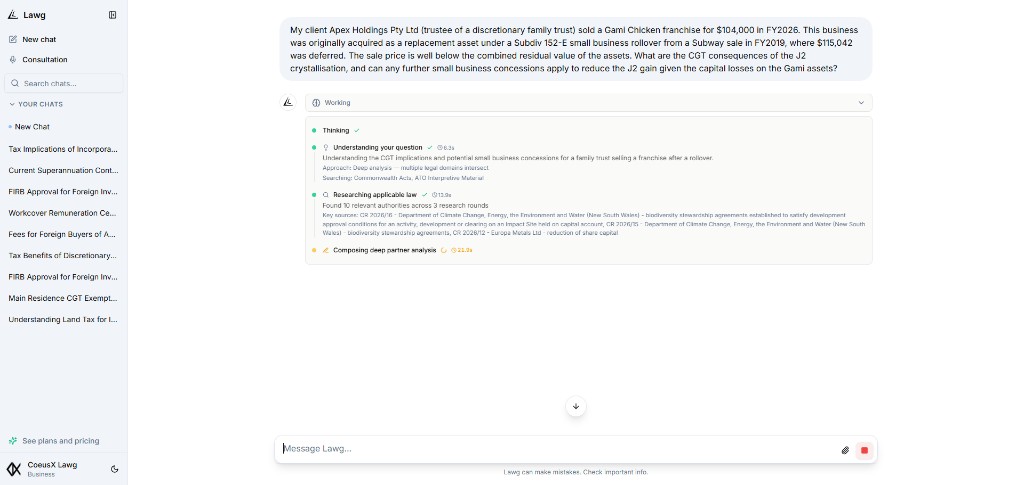
Questions about Division 7A or the small business CGT concessions can involve legislation, ATO guidance, judicial authority, and fact-sensitive exceptions. Lawg can help organise that research, but the practitioner must determine which provisions and authorities apply to the complete facts.
Lawg uses an indexed collection of Australian federal and selected state legislation, ATO materials, selected case law, and regulatory guidance. Coverage varies by topic and indexed sources may later be amended, withdrawn, or superseded.
2. Issue Spotting: Not Just Answering the Question You Asked
Related-issue prompts are intended to help practitioners widen the research frame without treating every possible issue as applicable.
When a client says "I run an IT consulting business as a sole trader. Most revenue comes from one client. I plan to sell the business within two years", most tools answer the CGT question. A well-trained practitioner sees more:
| Issue | Why it is triggered |
|---|---|
| Personal Services Income | "Most revenue from one client" (the 80% rule) |
| Contractor or employee | Single-client concentration raises workforce classification risk |
| CGT small business concessions | Division 152 (net asset value test, active asset test) |
| CGT discount eligibility | Two-year ownership timeline |
| GST implications | Sole trader turnover thresholds, enterprise cessation |
| Business structure | Sole trader may not be optimal for a planned sale |
Lawg can surface related tax considerations from the question and available facts. Those prompts are starting points for investigation, not conclusions that an issue applies.
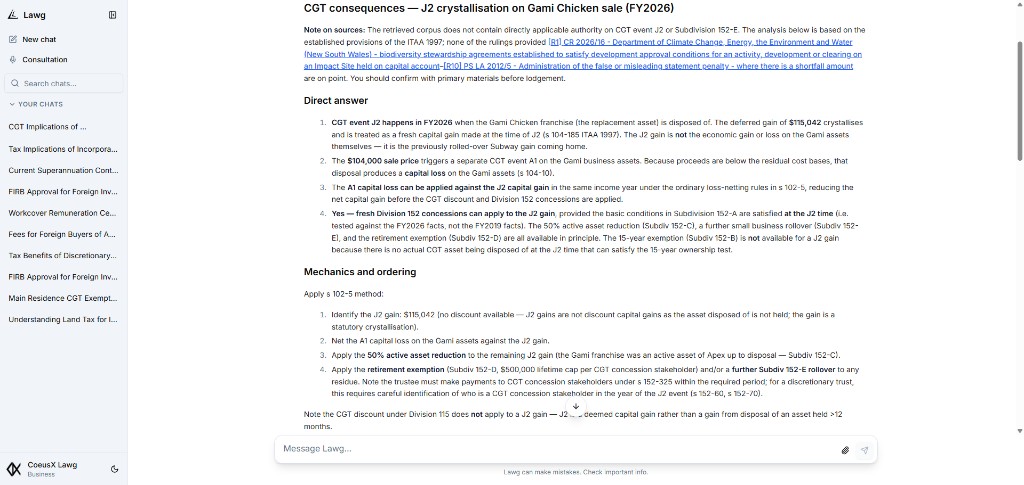
The goal is a more disciplined issue list: the primary question, connected risks, missing facts, and authorities that still need review.
Missing a connected issue can create professional risk. A practitioner should test each suggested issue against the engagement scope, the client's complete facts, and current authority.
3. From Research to Professional Work Product
Tax research is only useful if it becomes a document. Lawg now generates three types of professional output directly from your research:
Tax Advice Memo. A structured draft covering the issue, relevant facts and assumptions, applicable law, analysis, conclusion, and caveats.
Client Letter. A plain-English draft organised around background, advice, reasoning, practical implications, next steps, and qualifications.
File Note. An internal draft recording facts, assumptions, the issue considered, the position taken, supporting reasons, risks, and action items.
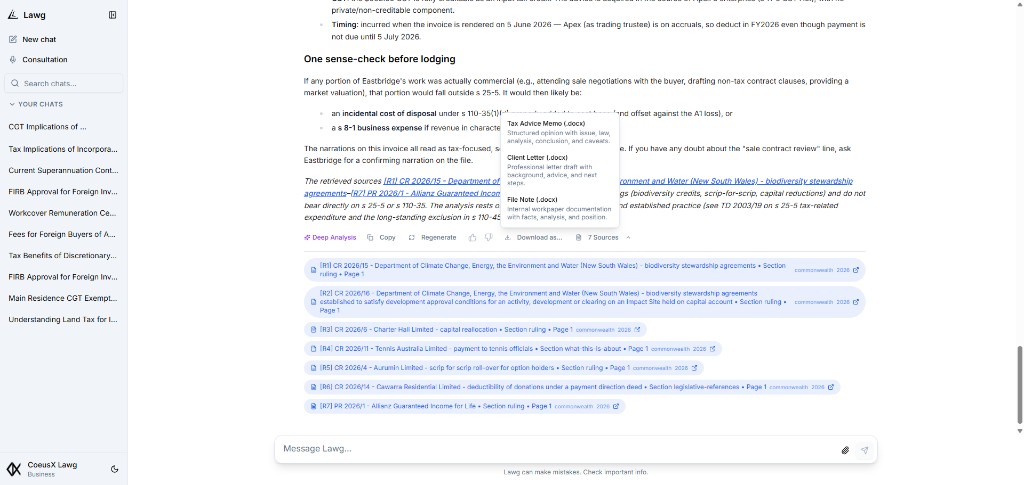
Supported workflows can generate a Word draft from the research. The practitioner should verify the analysis and citations, adapt the document to the engagement, and approve it before external use.
4. Click Any Citation. See the Source.
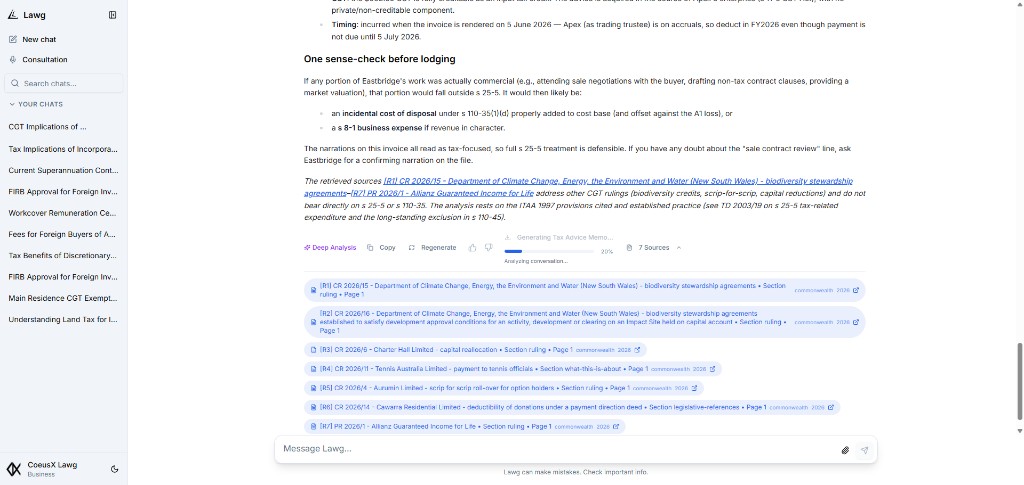
When an answer includes inline references or source cards, selecting a citation opens the source view and attempts to locate the relevant passage.
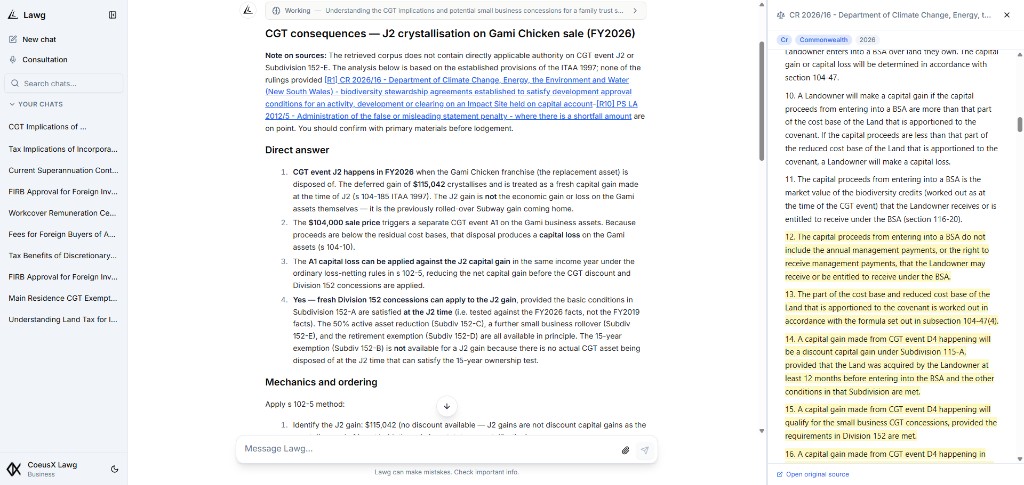
The source view is designed to reduce the work required to find the cited passage. Passage location can be approximate, so reviewers should read the surrounding text and confirm the citation themselves.
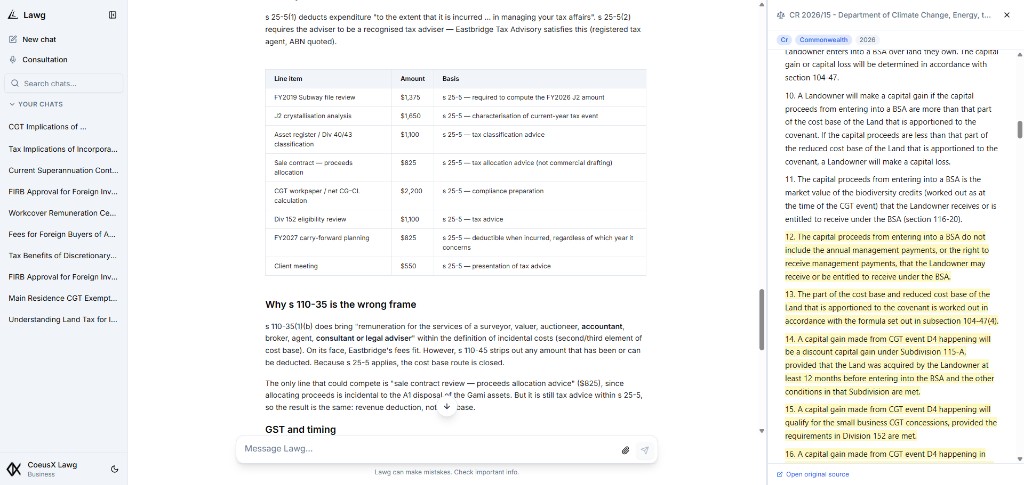
The passage locator accounts for common formatting differences between stored and rendered source text. If it cannot find the passage confidently, the interface should expose that limitation rather than treat the citation as verified.
Citations are review aids. Their presence does not prove that an answer is complete, current, or correctly applied to the client's circumstances.
5. Upload Documents, Then Ask Questions
Users can upload supported documents and ask questions about them within a research workflow. File acceptance does not establish that an extracted fact or tax treatment is correct; material details still require review against the source document.
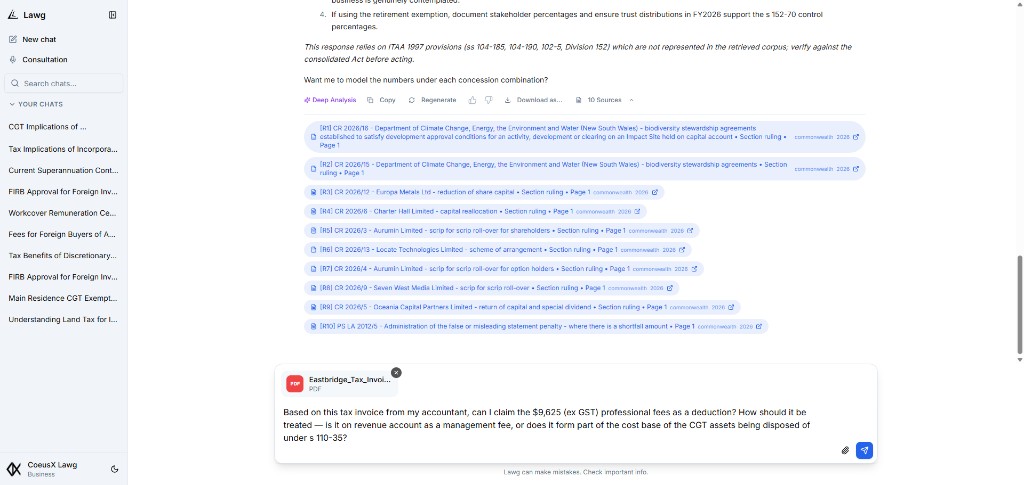
"Is this invoice GST-claimable?"
"What expense category should this be?"
"Are there any compliance issues with this receipt?"
Supported formats include PDF, DOCX, XLSX, CSV, TSV, IIF, RTF, TXT, JPEG, PNG, and WebP, subject to current size and validation limits.
6. Controls and Practitioner Review
Plan features and usage limits change over time. Check the current Lawg pricing page before making a purchasing decision.
Reliability is a continuing operating requirement, not a one-time launch claim. Practitioners should use visible citations, document validation, and their firm's own review and record-keeping controls when assessing an output.
What This Means for Your Practice
Lawg now covers the workflow that Australian tax practitioners actually follow:
- Research: investigate a question using retrieved Australian sources and inspect any references that support a material proposition.
- Issue spotting: consider related risks and opportunities, then determine which ones are supported by the facts.
- Drafting: Generate a Tax Advice Memo, Client Letter, or File Note directly from the research
The intended benefit is a connected workflow with explicit review points between research, issue selection, and professional drafting.
A practical review loop:
- Search the relevant source collections and retain the material authorities used in the analysis.
- Record uncertain assumptions and escalate questions that require specialist or expert review.
- Challenge plausible-sounding conclusions that are unsupported, incomplete, or based on non-existent authority.
- Reuse verified research when preparing different drafts, while preserving practitioner review for each intended audience.
Explore the current product at lawg.ai and review current plan details before starting a pilot.
Editorial note (4 September 2026): The Tax Practitioners Board guidance on AI and the Code of Professional Conduct, issued after this update was first published, reinforces practitioner responsibility for reviewing AI outputs, exercising professional judgement, and protecting client information.
Lawg is an AI-powered tax research and workflow tool. This is general information only and is not tax, legal, or financial advice. Professionals should exercise their own judgement when advising clients.