

Trust distribution minutes: a guide for trustees and advisers

Trust distribution minutes record how a trustee has exercised its discretion to appoint trust income or capital to beneficiaries.
For many discretionary trusts, the trustee must make a valid distribution resolution by 30 June, or by an earlier date required under the trust deed. The resolution must comply with the deed and create the intended beneficiary entitlements before the end of the income year.
A formally typed and signed minute is strong evidence, but the critical legal step is making the resolution on time. Records created after 30 June may sometimes evidence an earlier valid decision. They cannot be used to backdate a decision that was not actually made before the deadline.
If no beneficiary is validly presently entitled to part of the trust income, the trustee may be assessed under section 99 or section 99A of the Income Tax Assessment Act 1936. Section 99A can apply at the top marginal rate, with Medicare levy potentially applying depending on the circumstances.
Quick summary
Before finalising trust distribution minutes:
-
read the trust deed and identify its distribution deadline;
-
confirm how the deed defines trust income;
-
verify that each intended recipient is an eligible beneficiary;
-
determine whether the deed permits income classes or capital gains to be streamed;
-
make the trustee’s decision by 30 June or the deed’s earlier deadline;
-
clearly identify the amount, percentage or calculation method allocated to each beneficiary;
-
record franked distribution entitlements by 30 June;
-
carefully review the rules allowing capital gain entitlements to be recorded by 31 August;
-
review section 100A, family trust election and Division 7A risks;
-
retain contemporaneous evidence of the trustee’s decision;
-
never prepare or sign a backdated resolution.
This guide provides a practitioner framework. It is not a substitute for reviewing the particular trust deed and client facts.
Table of contents
Why trust distribution minutes matter
For a discretionary trust, the trust deed generally gives the trustee power to decide which beneficiaries will receive trust income or capital.
That decision can determine:
-
which beneficiary is presently entitled to trust income;
-
how the trust’s net income is assessed under Division 6 of Part III of the Income Tax Assessment Act 1936;
-
whether particular capital gains or franked distributions can be attributed to specific beneficiaries;
-
whether undistributed income may be assessed to the trustee;
-
whether integrity provisions such as section 100A apply;
-
whether family trust distribution tax or Division 7A issues arise.
A valid resolution must be more than an accounting entry prepared after the result is known. It must represent a genuine exercise of the trustee’s discretion in accordance with the trust deed.
Present entitlement in practice
A beneficiary will generally be presently entitled where they have an immediate, indefeasible right to demand payment of their share of trust income, subject to the terms of the trust.
For discretionary trusts, this entitlement normally arises because the trustee exercises its discretion before the end of the income year.
If the trustee does not validly exercise that discretion, the deed may:
-
make one or more default beneficiaries entitled;
-
retain the income as part of the trust fund;
-
produce an amount to which no beneficiary is presently entitled.
The tax consequences therefore depend on both the resolution and the default provisions of the deed.
Avoid stating that every failure produces a 47% assessment
It is too broad to say that every missing minute automatically causes all trust income to be taxed at 47%.
The outcome may depend on:
-
whether the deed names default beneficiaries;
-
whether part of the income was validly appointed;
-
whether section 99 or section 99A applies;
-
the identity and status of the relevant beneficiary;
-
whether Medicare levy applies to the trustee’s assessment;
-
whether separate rules apply to capital gains or franked distributions.
The practical message remains serious: a missed or invalid resolution can produce an unexpectedly high trustee assessment, but the exact result must be determined from the deed and the tax law.
Must the resolution be made by 30 June?
The Australian Taxation Office states that trustees of discretionary trusts generally need to make valid resolutions to appoint or distribute trust income to beneficiaries by 30 June of the relevant income year.
The trust deed may require the decision to be made earlier. An earlier deed deadline cannot be overridden by the tax law deadline.
Before treating 30 June as the relevant date, check:
-
the deed’s definition of the accounting period;
-
the deadline for exercising the distribution power;
-
whether the deed requires written notice or a particular form of resolution;
-
whether the trustee can distribute by amount, proportion or formula;
-
whether separate classes of income can be streamed;
-
whether the deed contains default beneficiary provisions.
The resolution must be valid under the deed. A resolution made by 30 June is not effective if the trustee did not have the power to make it in that form.
Can the written minute be prepared after 30 June?
Potentially—but only where the trustee actually made the valid resolution on or before the required date.
The ATO accepts that a document created after 30 June may provide evidence of an earlier decision. For example, contemporaneous evidence might include:
-
a signed distribution worksheet;
-
a trustee resolution circulated electronically;
-
meeting notes recording the decision;
-
written approvals from the relevant decision-makers;
-
accounting instructions issued before year-end.
A later formal minute should accurately record the earlier decision. It must not create a new distribution after the deadline.
What is not acceptable
A trustee should not:
-
decide the distribution after year-end and date it 30 June;
-
sign an August resolution stating that it was made in June when it was not;
-
alter a signed document without preserving the amendment history;
-
create supporting emails or worksheets retrospectively;
-
rely on unsigned drafts where there is no other evidence of a decision.
Backdating is not a remediation strategy. It creates evidentiary, professional and potentially legal risks.
Best practice
Even where the deed does not expressly require a signed written resolution, the safest process is to complete and approve a clear written record before the deadline.
This reduces disputes about:
-
whether the resolution was made;
-
when it was made;
-
who participated in the decision;
-
what was allocated;
-
whether the wording complied with the deed.
What must be checked before drafting the resolution?
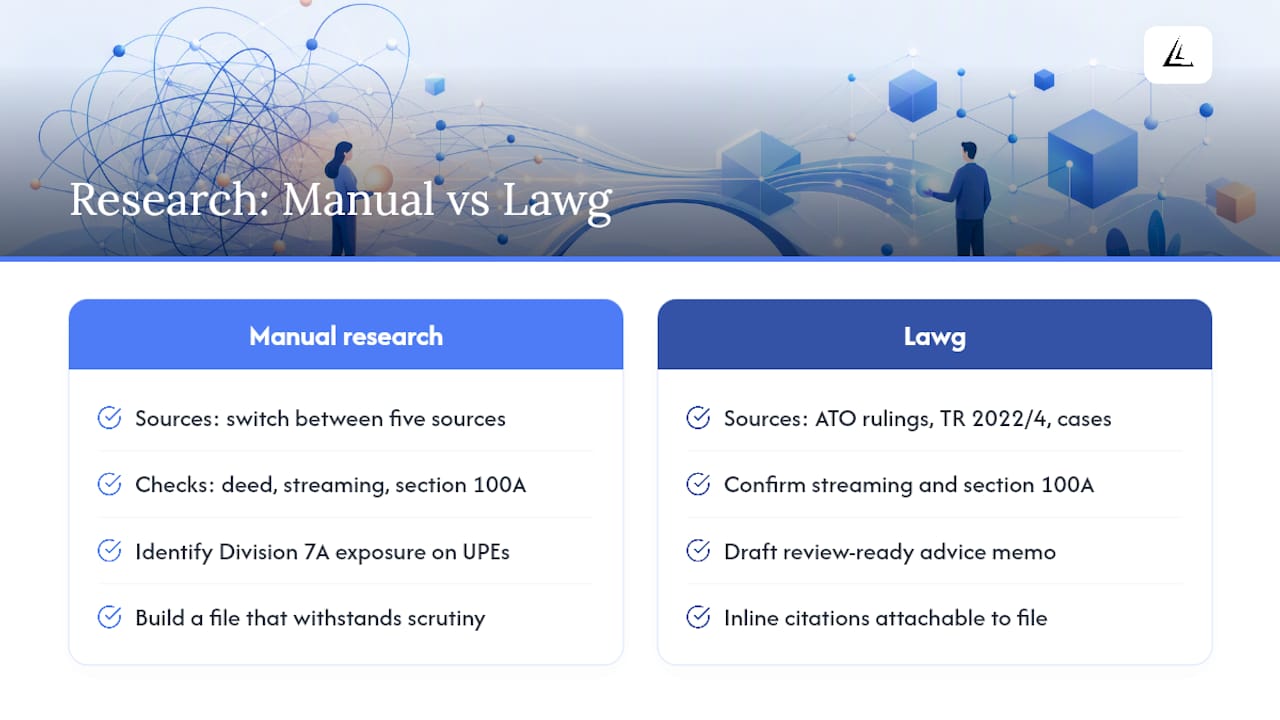
1. The trust deed
Review the executed deed, including all amendments and variations.
Confirm:
-
the trustee’s distribution powers;
-
the definition of income;
-
whether capital gains are treated as income or capital;
-
whether income classes can be streamed;
-
the eligible beneficiary class;
-
any excluded beneficiaries;
-
the decision deadline;
-
execution and meeting requirements;
-
default beneficiary provisions.
Do not rely solely on last year’s minute or a generic template.
2. Beneficiary eligibility
Confirm that every proposed recipient falls within the beneficiary class.
Use the beneficiary’s complete legal name and correct capacity. For a company, verify the company name and ACN. For another trust, identify the trustee and trust capacity correctly.
3. Family trust elections and interposed entity elections
Where a family trust election or interposed entity election is in force, confirm that proposed distributions remain within the relevant family group or otherwise do not produce family trust distribution tax.
4. TFN reporting
Closely held trusts should review whether beneficiaries have quoted their tax file numbers and whether any TFN reporting or withholding obligations arise.
This should be checked before the distribution is finalised rather than discovered during preparation of the tax return.
5. Estimated trust income
The final accounts do not need to be completed by 30 June before the trustee can make a resolution.
Where final figures are unavailable, the deed may permit allocations using:
-
percentages;
-
fixed amounts;
-
formulas;
-
balance or residue clauses;
-
classes of income.
The wording must be sufficiently certain and valid under the deed.
6. Related tax risks
Before the trustee decides, consider:
-
section 100A reimbursement agreements;
-
Division 7A and Subdivision EA;
-
unpaid present entitlements;
-
family trust distribution tax;
-
non-resident beneficiaries;
-
beneficiaries under a legal disability;
-
exempt entities;
-
capital gain and franked distribution streaming;
-
trust losses and recoupment rules;
-
integrity or anti-avoidance provisions.
How streaming rules affect capital gains and franked distributions
The tax rules allow beneficiaries to be made specifically entitled to certain trust capital gains and franked distributions where the trust deed permits it.
Specific entitlement involves two broad requirements:
-
the beneficiary must receive, or reasonably be expected to receive, financial benefits referable to the gain or franked distribution; and
-
the entitlement must be recorded in its character as referable to that gain or distribution.
A general entitlement to “the balance of trust income” does not necessarily create a specific entitlement to a capital gain or franked distribution.
Franked distributions
For a franked distribution, the entitlement must generally be recorded in the trust’s accounts or records by the end of the income year.
That means the relevant character should be dealt with by 30 June.
The resolution should clearly identify the franked distribution or class of franked distributions and the beneficiary intended to receive the corresponding financial benefit.
Other integrity requirements, including the qualified person rules, may still affect access to franking credits.
Capital gains
For a capital gain, the tax law may allow the entitlement to be recorded in its character up to two months after the end of the income year—generally 31 August.
This does not give the trustee an unrestricted right to redistribute a capital gain after 30 June.
For example, the trustee may be unable to create a new specific entitlement after year-end if:
-
the gain formed part of trust income already appointed to another beneficiary;
-
default beneficiaries became entitled to the relevant trust income at 30 June;
-
the proposed entitlement is inconsistent with the deed;
-
the beneficiary cannot reasonably be expected to receive the relevant financial benefit.
The 31 August rule is therefore a recording rule within the specific entitlement provisions, not a general extension of the trustee’s ordinary distribution deadline.
What should a trust distribution minute contain?
There is no universal wording suitable for every trust.
A well-prepared minute will generally identify:
-
the full name of the trust;
-
the full legal name and capacity of the trustee;
-
the date the decision was made;
-
the income year concerned;
-
the deed and relevant distribution power;
-
the trustee’s determination of distributable income, where appropriate;
-
each beneficiary and their entitlement;
-
whether the entitlement is a fixed amount, percentage or formula;
-
any balance or residue allocation;
-
any separate treatment of capital gains or franked distributions;
-
any assumptions on which the resolution depends;
-
evidence of approval by the trustee or corporate trustee.
Avoid wording that is:
-
inconsistent with the deed;
-
incapable of calculation;
-
internally contradictory;
-
dependent on a future discretionary decision;
-
unclear about the beneficiary or capacity;
-
copied from a prior year without checking current facts.
Illustrative resolution structure
The following is an educational structure only. It is not a complete legal template and should not be used without checking the deed and obtaining appropriate advice.
TRUSTEE RESOLUTION — [TRUST NAME]
Trustee: [full legal name and capacity]
Trust: [full name of trust]
Deed: [date of original deed and relevant amendments]
Income year: Year ending 30 June [year]
Date of resolution: [actual date the decision was made]
The trustee notes that it has reviewed:
-
the terms of the trust deed;
-
the estimated income and capital position of the trust;
-
the identity and eligibility of the proposed beneficiaries;
-
the tax and administrative matters relevant to the proposed appointments.
Pursuant to clause [number] of the trust deed, the trustee resolves that the distributable income of the trust for the income year ending 30 June [year] be appointed as follows:
| Beneficiary | Entitlement |
|---|---|
| [Full legal name and capacity] | [Fixed amount, percentage or valid formula] |
| [Full legal name and capacity] | [Fixed amount, percentage or valid formula] |
| [Full legal name and capacity] | [Valid balance or residue clause, if permitted] |
Separate income classes or streaming
Where permitted under the deed, the trustee further resolves that:
-
[beneficiary] is entitled to [clearly identified franked distribution or class], together with the financial benefits referable to that distribution; and/or
-
[beneficiary] is entitled to the financial benefits referable to [identified capital gain], subject to the deed and the specific entitlement rules.
The trustee authorises the appropriate entries to be made in the trust’s records and beneficiary accounts consistently with this resolution.
Approval
[Insert the execution or approval process required by the deed, trustee structure and applicable company constitution.]
This structure deliberately uses placeholders. The correct formulation depends on the deed’s language and the intended tax outcome.
Section 100A and reimbursement agreement risks
Section 100A of the Income Tax Assessment Act 1936 is an integrity provision concerning certain beneficiary entitlements arising from reimbursement agreements.
The ATO’s view in Taxation Ruling TR 2022/4 identifies four broad requirements:
-
a beneficiary is presently entitled to a share of trust income;
-
the entitlement arises out of, or in connection with, an agreement;
-
the agreement provides for a benefit to someone other than the beneficiary;
-
at least one purpose of the agreement is reducing an income tax liability.
Section 100A does not apply where the agreement was entered into in the course of an ordinary family or commercial dealing.
That exception requires consideration of the whole arrangement. It should not be assumed merely because the participants are family members.
Common areas requiring review
Examples that may require closer analysis include:
-
an adult child is made presently entitled but the funds are returned to the parents;
-
a beneficiary’s entitlement is used to pay another person’s mortgage or personal expenses;
-
funds circulate back to the trust or an associated entity;
-
a beneficiary receives no real economic benefit;
-
the same low-tax beneficiary is selected under a pre-arranged annual pattern;
-
a corporate beneficiary’s entitlement remains unpaid while trust funds are used for shareholders or associates.
The ATO’s compliance approach is set out in PCG 2022/2.
The practitioner should examine the actual cash flows and arrangements, not only the wording of the minute.
Corporate beneficiaries, UPEs and Division 7A after Bendel
A distribution to a private company may create an unpaid present entitlement where the company becomes entitled to trust income but the amount is not paid.
The Division 7A position changed materially following the High Court’s decision in Commissioner of Taxation v Bendel [2026] HCA 18.
The High Court confirmed that a corporate beneficiary’s unpaid present entitlement is not, without more, a loan for the purposes of section 109D merely because it remains unpaid.
That does not mean UPE arrangements are free from Division 7A or other integrity risks.
Practitioners should still consider:
-
whether the entitlement was later converted into or replaced by an actual loan;
-
whether the company took other action that falls within the statutory definition of a loan;
-
whether the trustee made a payment or loan to a shareholder or associate;
-
whether Subdivision EA applies;
-
whether section 100A applies;
-
whether the accounting records reflect the legal arrangements;
-
whether the trust funds were used for the private benefit of individuals;
-
whether previous complying loan arrangements remain on foot.
The ATO’s Bendel Decision Impact Statement states that a UPE simply left outstanding will not, without more, be treated as a section 109D loan. The legal character of later dealings remains important.
For more detail, see Lawg’s Division 7A research guide.
Signing and record-keeping
Who approves the resolution?
The approval process depends on:
-
whether the trustee is an individual or company;
-
the trust deed;
-
applicable trust law;
-
the company constitution or replaceable rules;
-
whether the decision is made at a meeting or by circular resolution.
Do not assume every trustee structure uses the same signing block.
For a corporate trustee, the company should also comply with its corporate decision-making and minute-keeping obligations.
Records to retain
The client file should generally include:
-
the current executed trust deed and amendments;
-
a deed summary;
-
the signed or otherwise approved resolution;
-
contemporaneous worksheets and instructions;
-
estimated income calculations;
-
final trust accounts;
-
beneficiary details;
-
FTE or IEE records;
-
TFN declarations and reporting records;
-
section 100A analysis where relevant;
-
UPE and Division 7A analysis;
-
evidence of payments or applications of distributions;
-
practitioner review notes.
Records created after year-end should be clearly identified as evidence or formalisation of the earlier decision, not presented as though they were created on 30 June.
A practical annual workflow
A repeatable process reduces deadline risk.
Step 1: Review the deed
Confirm the deadline, income definition, beneficiary class, streaming powers and execution requirements.
Step 2: Update beneficiary information
Review names, entities, TFNs, residency, legal disability, family group status and related elections.
Step 3: Estimate the trust position
Prepare a reliable estimate of accounting income, taxable income, capital gains, franked distributions and relevant deductions.
Step 4: Identify tax issues
Review section 100A, Division 7A, Subdivision EA, trust losses, family trust distribution tax and other integrity rules.
Step 5: Obtain trustee instructions
Explain the available options, assumptions and risks. The trustee—not the adviser—must make the distribution decision.
Step 6: Draft the resolution
Use wording consistent with the deed and the intended entitlements.
Step 7: Approve before the deadline
Complete the required trustee or director approval by 30 June or the earlier deed date.
Step 8: Preserve evidence
Retain the resolution, approval evidence, calculations and communications.
Step 9: Finalise the accounts
Check that the final accounts and beneficiary accounts reflect the resolution.
Step 10: Reconcile tax reporting
Ensure the tax return, distribution statements, TFN reporting and supporting workpapers remain consistent with the legal entitlement.
Pre-signing checklist
-
The current trust deed and all amendments have been reviewed.
-
The deed deadline has been identified.
-
The deed’s definition of income has been confirmed.
-
The trustee has the power to make each proposed appointment.
-
Every recipient is an eligible beneficiary.
-
Beneficiary names and capacities are accurate.
-
Relevant TFN reporting obligations have been checked.
-
FTE and IEE consequences have been considered.
-
Estimated accounting and taxable income have been reviewed.
-
Capital gains and franked distributions have been identified.
-
Streaming powers and specific entitlement rules have been checked.
-
Section 100A risks have been documented.
-
Corporate beneficiary and UPE arrangements have been reviewed in light of Bendel.
-
Subdivision EA has been considered where trust funds benefit shareholders or associates.
-
The allocations are sufficiently certain and consistent with the deed.
-
Any balance clause is valid under the deed.
-
The resolution records the actual date of the decision.
-
The appropriate trustee or corporate approval process has been followed.
-
Contemporaneous evidence has been retained.
-
The document has not been backdated.
-
Final accounts and tax reporting will be reconciled to the resolution.
How Lawg supports trust distribution research
Preparing trust distribution minutes requires more than inserting beneficiary names into a template.
The adviser may need to research:
-
the Division 6 present entitlement rules;
-
the ATO’s trustee resolution guidance;
-
capital gain and franked distribution streaming;
-
section 100A and TR 2022/4;
-
corporate beneficiaries and UPEs after Bendel;
-
Subdivision EA and Division 7A;
-
the interaction between the deed and the intended tax treatment.
Lawg helps Australian accountants and tax practitioners research these connected issues, review the supporting Australian authorities and organise the analysis into professional drafting formats.
Its role is to support research and preparation. The trustee must make the distribution decision, and the practitioner remains responsible for checking the deed, facts, authorities and final advice.
Explore Lawg for Australian tax professionals
You can also read our guide to evaluating AI tax research platforms.
Authoritative sources
The following sources should be reviewed where relevant:
This article provides general information for Australian trustees and professional advisers. It does not constitute tax or legal advice. Trust deeds and client circumstances differ, and the relevant law and ATO guidance should be checked before a resolution is made.