
A general interest charge (GIC) remission request can be difficult to review when the account records, dates, documents and client explanations are not organised before the narrative is prepared. Start by making the record clear: what happened, what supports it and what still needs checking.
The ATO’s remission guidance asks for information about the circumstances affecting payment, their connection to the delay, mitigation and supporting evidence. Payment and compliance history may also be relevant. Section 8AAG of the Taxation Administration Act 1953 is the statutory remission provision; check the applicable version alongside the current ATO guidance when preparing a request.
This article suggests an internal preparation workflow. It does not assess eligibility or predict the outcome of a remission request. The checklist, status labels and placeholders below are working tools, not an ATO-prescribed process or a substitute for the relevant application form.
Go to the short preparation checklist.
1. Start with the record, not the argument
Persuasive language cannot resolve an incorrect balance, an uncertain due date or a statement that is not supported by its cited document. Begin with a short matter scope so the preparer and reviewer are working on the same taxpayer, charge and period.
A suggested scope record identifies:
- the taxpayer or entity and relevant accounts;
- the charge type and underlying liabilities;
- the reporting periods and payment due dates;
- the GIC period and amount, with an “as at” date; and
- the preparer, intended reviewer and purpose of the working draft.
Confirm whether the matter concerns GIC, shortfall interest charge or a failure-to-lodge penalty. Before submission, check the ATO’s current request instructions and obtain the relevant form. A scope record is not an eligibility assessment.
2. Confirm the account position and relevant dates
ATO guidance explains that GIC is calculated daily and continues while an overdue debt remains. Record the date attached to any amount rather than presenting it as a permanently fixed figure.
The ATO’s tax accounts guide describes transaction histories, balances, downloads and processed/effective-date filters. Those records can help you assemble the account history for review.
Useful fields to record and reconcile include:
- account name, identifier and sequence number where applicable;
- liability type, reporting period, original amount and due date;
- posting dates, amendments and revised liabilities;
- payments, credits, offsets and transfers;
- processed and effective dates where they differ;
- payment-plan or deferral information;
- GIC transactions, principal debt and account balance; and
- the date the account information was downloaded.
Relevant documents may include assessments, account statements, activity statements, debt notices, payment receipts and ATO correspondence. Give each a simple reference, such as ATO-01, BANK-02 or CORR-03, and record its date, source, relevant period and review status.
An older notice may no longer show the current position. Later payments, amendments, transfers or credits may explain a different balance. Reconcile those movements before treating a figure as established in the working draft.
3. Build the event-and-payment timeline
Create one chronology that connects the events, their reported effect on payment and the records available to check them. Include events before the due date where they provide necessary context.
| Date or period | Event or action | Effect on payment | Supporting record | Fact-support status |
|---|---|---|---|---|
| Exact date or defined period | What happened or what action was taken | What changed, if anything | Document reference and relevant passage | Supported, partly supported, not supported, unverified or contradicted |
The timeline may cover the liability and due dates; the beginning and end of the reported circumstances; when the client became aware of the issue; attempts to obtain funds or make payment; ATO or practitioner communications; partial payments; and when payment resumed. Mark periods that remain unexplained.
Distinguish an event’s date from the date it began affecting payment. For example, losing a major customer and experiencing the resulting cash-flow effect may occur at different times. The file should identify both dates where relevant, rather than assuming the connection.
4. Separate documents held from facts supported
A document being present in the file does not automatically establish the factual statement attributed to it. Document status asks whether it has been received and reviewed. Fact-support status asks what the evidence establishes about a particular statement.
Suggested document-status labels
| Document status | Meaning |
|---|---|
| Received — not yet reviewed | The document is held, but its contents have not been assessed. |
| Reviewed | The document has been examined for relevance and support. |
| Outstanding | The document has been requested or identified but is not yet held. |
Suggested fact-support labels
| Fact-support status | Meaning |
|---|---|
| Supported | The available evidence supports the statement for the relevant period. |
| Partly supported | Some of the statement is supported, but not the full proposition. |
| Not supported | The document does not establish the statement attributed to it. |
| Unverified | The statement has not yet been checked against reliable records. |
| Contradicted | Available evidence is inconsistent with the statement. |
These are suggested internal labels, not an ATO-prescribed evidence classification system.
Example: a bank statement is not the whole explanation
Suppose a client says the business had no access to funds during March and provides a March bank statement. The statement may show a low balance, but not establish that no funds were accessible throughout the month, that no other accounts or facilities existed, or that the balance prevented payment of the relevant liability.
After review, the document might be marked Reviewed while the broader statement remains Partly supported. Record what the document actually supports, including its limits, rather than what you expected it to establish.
5. Record evidence gaps and open questions
Maintain a visible record of documents held, documents reviewed, supported facts, unverified client statements, outstanding documents and unanswered questions. A client statement should remain identified as such until it has been checked.
Questions for the working file can include:
- Which liability and account generated the GIC, and what was the due date?
- Which GIC period is being examined, and is the amount dated?
- Have payments, credits, amendments and transfers been reconciled?
- What event is said to have affected payment, and which dates are supported?
- How is the reported effect on payment supported?
- What actions were taken, and when was the ATO contacted?
- Does the explanation agree with the account and payment records?
- Which periods remain unexplained, which records conflict and which statements remain unverified?
Not every question must be resolved before drafting begins. The control is to keep unresolved matters visible, rather than silently converting them into established facts.
6. Build a working draft without overstating certainty
A working draft can help identify missing evidence while the file is being assembled. Use clear placeholders where work is unfinished:
- [DATE TO CONFIRM]
- [CLIENT STATEMENT — NOT YET VERIFIED]
- [DOCUMENT RECEIVED — REVIEW PENDING]
- [PARTIAL SUPPORT ONLY]
- [OPEN QUESTION]
- [ATO ACCOUNT RECONCILIATION REQUIRED]
These placeholders are an internal drafting method, not an ATO requirement or final application wording.
Keep each statement within the evidence. A medical certificate covering one week does not automatically support incapacity over several months. A file note recording a client’s account is not independent verification of the event. An earlier account balance is not necessarily the current balance.
Where support is partial, state the supported portion and leave the remainder open. Where records conflict, flag the inconsistency rather than choosing the more favourable version without explanation.
7. Prepare the file for practitioner review
A pre-review pack can bring together the scope and account summary, account extracts, notices, chronology, document register, fact-support statuses, open questions and working draft. The reviewer should be able to tell what is held, what has been checked, what supports the explanation and what is outstanding.
The next step may be to continue drafting with visible placeholders, request documents, reconcile a figure, narrow a statement, raise conflicting records with the client or obtain further professional analysis. Review does not require every open item to disappear.
Before finalising a request, recheck current ATO guidance and obtain the relevant form for that application. A well-organised file supports review; it does not establish that remission will be granted.
Short GIC preparation checklist
Use this as a suggested internal preparation workflow, not an official form or a completion test for entitlement.
- Scope: identify the taxpayer, charge, accounts, liabilities, periods, preparer and reviewer.
- Account: record dated balances, due dates and transactions; note any reconciliation still required.
- Timeline: connect events, reported effects on payment and actions to identifiable records.
- Documents: separate received, reviewed and outstanding records.
- Fact support: distinguish supported, partly supported, not supported, unverified and contradicted statements.
- Working draft: retain placeholders, limits and unresolved questions.
- Review: agree proposed next actions and check current sources and application instructions before finalisation.
When the file moves to another colleague, the tax research handover checklist can help organise the research position and remaining actions.
From the evidence question to a working note in Lawg
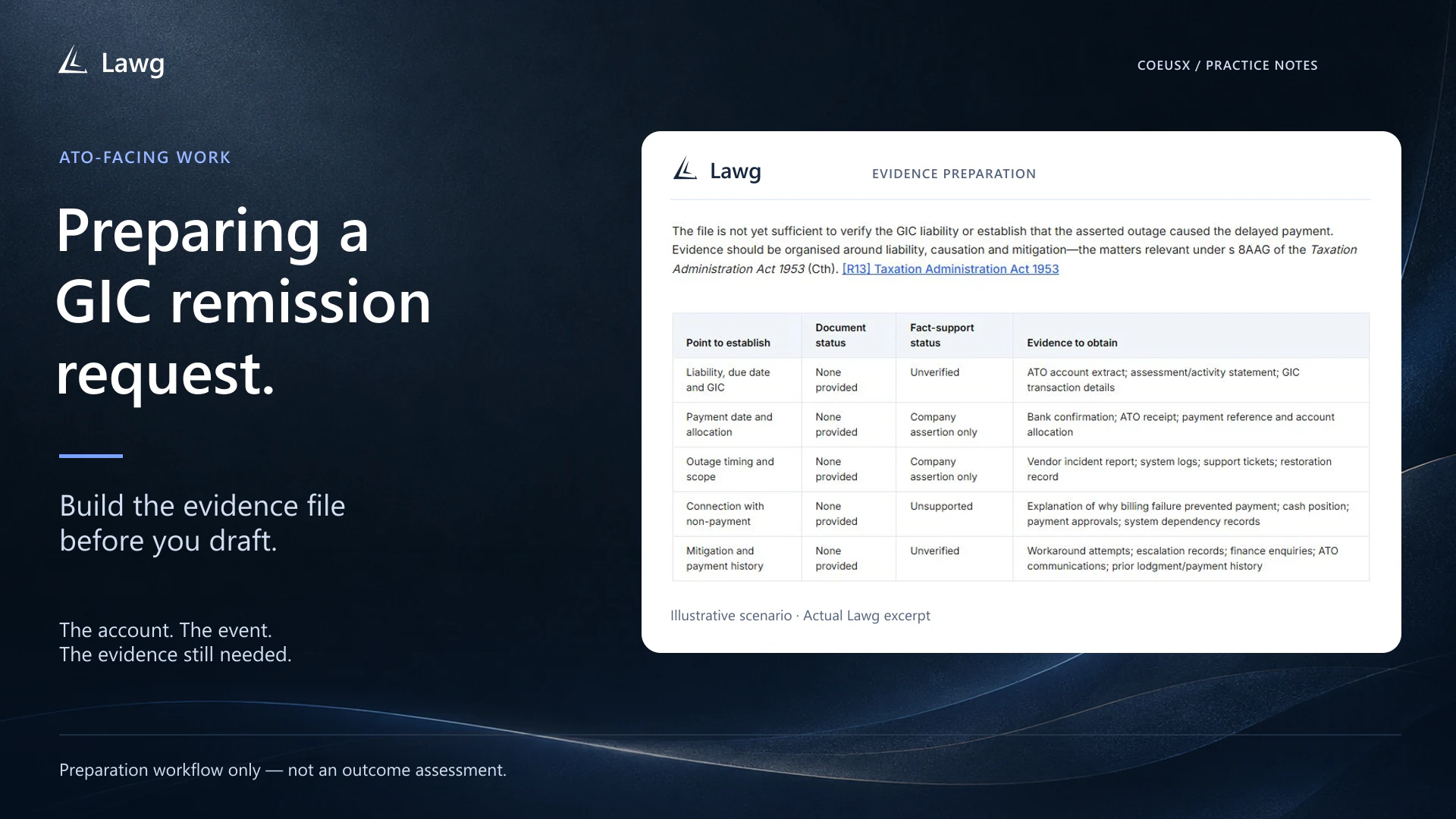
Lawg is an Australian tax engine for accountants. In a product demonstration captured on 1 October 2026, we supplied an illustrative company scenario: a reported payment delay, a reported billing-system outage and gaps in the account and supporting records.
Lawg produced a preparation table separating the points to establish, document status, fact-support status and evidence still to obtain. We opened a cited statutory source in the side panel, then asked for an internal working note. The note retained unverified scenario inputs, source limitations and proposed next actions.
The cover shows an excerpt of that actual preparation table. No client documents were uploaded or reviewed. The working note was a chat response, not an exported document or a request submitted to the ATO. In the follow-up, Lawg identified limited current-turn source retrieval and other official links needing rechecking; opening a reference did not certify its currency or application.
The practical starting point is a file someone else can follow: the question, available records, evidence gaps and work still to do. Explore Lawg with a non-client example, and read Lawg’s methodology for its source and review boundaries.
Official sources and further checking
Use the primary sources for the applicable law and current process. This article does not set out the statutory tests, assess a client’s circumstances or replace professional judgement.
- ATO — Remission of interest charges.
- ATO — How to request a remission of interest and failure to lodge penalties.
- ATO — Tax accounts in Online services for agents.
- Federal Register of Legislation — Taxation Administration Act 1953, section 8AAG. Confirm the version relevant to the matter.
General preparation information, not tax, legal or financial advice. Professional review remains required before using a draft. Lawg does not guarantee ATO acceptance or any tax outcome.
Published by CoeusX. To report a correction, contact CoeusX.