
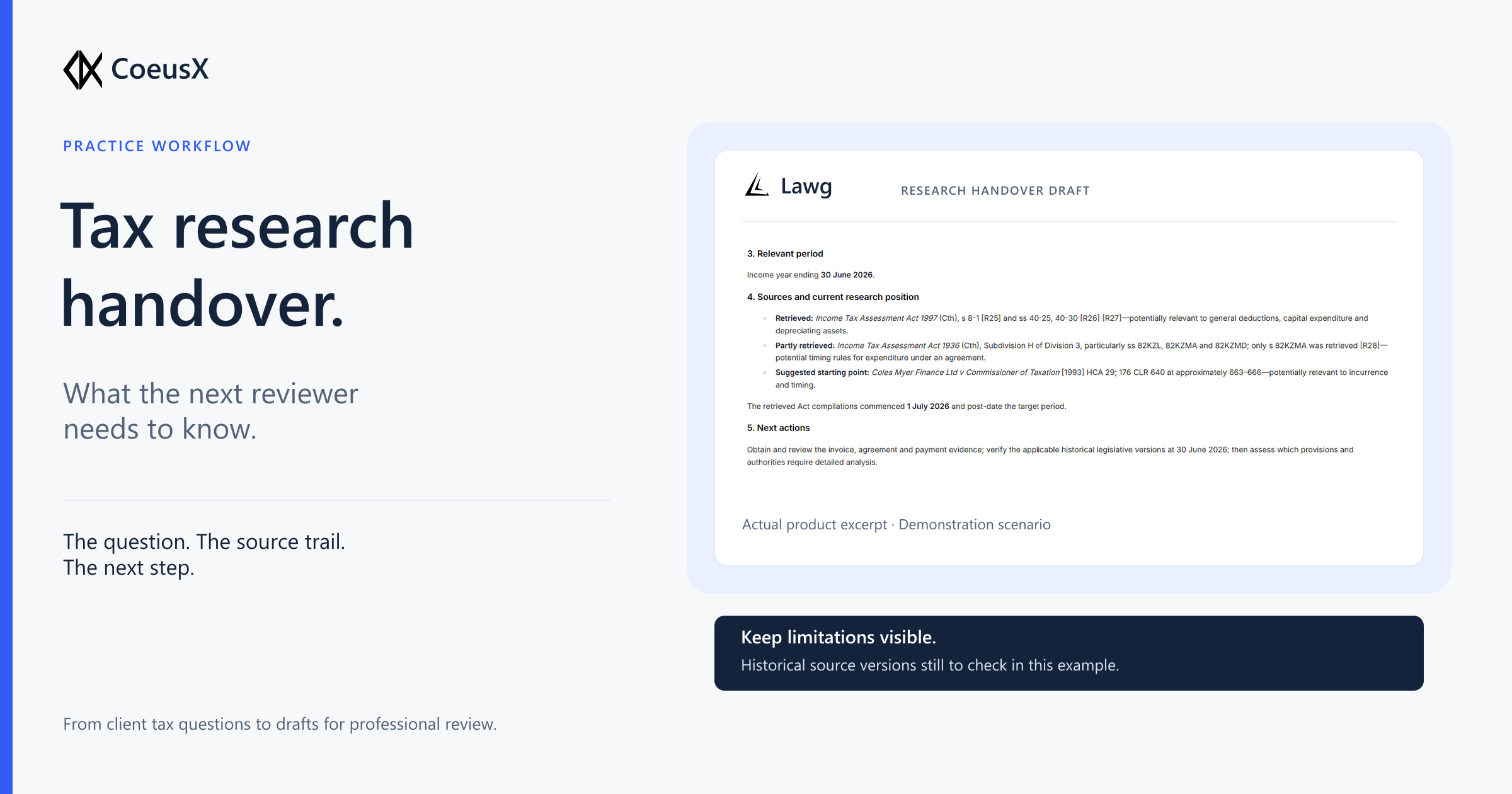
Tax research often moves between people before a final position is reached. A colleague may need to review the work, continue it after more information becomes available, or prepare the next internal document.
A useful handover therefore needs more than a list of links or copied extracts. It should help the receiving colleague understand:
- what question was researched;
- which facts were used;
- which period and source versions matter;
- what material was reviewed;
- where the research currently stands;
- what remains uncertain; and
- what needs to happen next.
This article explains how to organise that information for internal handover and practitioner review. It does not provide tax advice, and completing the checklist does not guarantee that the research is correct, complete, compliant or approved.
Go to the short checklist or download the printable one-page checklist (PDF).
Why a clear research handover matters
The person who begins the research may not be the person who completes or approves it. Work may move to a manager, partner, specialist or another team member because further facts are needed, a deadline is approaching or a technical issue requires another level of review.
Without a clear handover, the receiving colleague may need to reconstruct:
- the original question;
- the factual background;
- the researcher’s assumptions;
- which authorities were considered;
- why a source was considered relevant;
- whether a working view was reached; and
- which matters remain unresolved.
A good handover does not make preliminary research appear final. It gives the next authorised colleague a clear starting point and a visible research trail.
Start with the research question and scope
Begin with the exact question the research was intended to address.
A broad topic such as “research the tax treatment of this payment” may not give the next colleague enough direction. The handover should record:
- the question in one clear sentence;
- why the research was requested;
- the intended internal user and required output;
- the relevant jurisdiction, tax or regime, and entity type where they affect the question;
- what was included in the research; and
- what remained outside scope.
Also state whether the facts and scope are settled or provisional. If a missing fact or later event could change the question, make that clear.
The purpose is not to make the completed work appear broader than it is. It is to show exactly what the researcher was asked to investigate.
Separate facts, assumptions and missing information
A reviewer needs to know not only what information was used, but also how reliable that information currently is.
Separate the factual record into clear categories:
- Confirmed facts: Information supported by an identified document, record or other reliable source.
- Reported but unverified information: Information provided by a client, stakeholder or colleague that has not yet been checked against supporting records.
- Assumptions: Working positions used to continue the research while information remains incomplete.
- Missing information: Facts or documents that are still required.
For each material fact, record its source and verification status. Note any inconsistency between documents, accounting records, correspondence or instructions.
Keep facts separate from technical interpretations. A transaction date shown on an executed agreement may be a confirmed fact. The possible tax consequence of that date is part of the analysis and remains subject to review.
Record the relevant dates, period and source versions
Tax research should make its time frame visible. Record the relevant:
- transaction, event or decision date;
- income year, financial year, FBT year or reporting period;
- date at which the research is intended to apply; and
- date on which the research was prepared or last updated.
Research completed today may concern an earlier event. The current online version of legislation or guidance may not be the version relevant to that event.
Where timing is material, record:
- the point-in-time version or compilation of legislation relied upon;
- the status and applicable date of relevant rulings or guidance;
- whether the law changed before, during or after the relevant period; and
- any commencement, application or transitional provision that may require further review.
An online access date is useful, but it does not replace the source’s compilation date, date of effect or application period.
Create a source trail another reviewer can check
The source record should allow another colleague to locate the exact material, understand why it was considered and check whether it supports the research.
For each material source, record:
- the source type;
- the full title;
- the issuing authority, court or tribunal;
- the legislation identifier, ruling number or case citation;
- a stable section, subsection, item or paragraph reference;
- a direct link to the authorised or primary source where reasonably available;
- the relevant version, status and date;
- what the source appears to support; and
- any material limitation, qualification or contrary authority.
Where helpful, separate:
- Authorities relied upon in forming the current working view;
- Other material sources reviewed but not relied upon, including material that was superseded, factually distinguishable, outside the relevant period or inconclusive.
A document title or homepage link is not enough on its own. The receiving colleague should be able to identify the relevant passage and understand its role in the research.
Useful public source collections
ATO Legal Database
The database provides access to material including legislation, public rulings, practical compliance guidelines, cases, decision impact statements, ATO interpretative decisions, practice statements and taxpayer alerts. It can help practitioners identify the source type, document number and relevant passage used in the research.
Federal Register of Legislation
The Register is the authorised whole-of-government website for Commonwealth legislation and related documents. It contains the text and lifecycle of laws, including point-in-time versions for relevant materials, and supports checks of compilations and applicable periods.
Federal Court of Australia — Judgments
The Court’s judgments collection provides access to Federal Court decisions, including searchable judgments dating from 1977. It supports recording the correct case citation and pinpoint paragraphs rather than relying only on a summary.
These sources are useful research starting points. They do not officially endorse this checklist.
State the current research position
The handover should contain a distinct record of where the research currently stands.
Where a preliminary view has been reached, record:
- the view in short form;
- the material facts on which it depends;
- the main authorities that appear to support it;
- what remains uncertain or requires further checking; and
- whether material contrary authority or a different factual characterisation could affect it.
Keep this section practical. It is not a substitute for a full technical analysis or final advice.
A suitable format may be:
Preliminary view: [Short working position]
Main support: [Material facts and principal sources]
Still to check: [Missing facts, source issue or further research]
Contrary material: [Any other material view or authority]
If no preliminary view has been reached, say so and explain why. For example:
No preliminary view has been reached because the final agreement and relevant transaction date have not yet been confirmed.
This is more useful than leaving the field blank or stating only that further research is required.
Make unanswered questions and limitations visible
A useful handover shows where the research ends as well as what has been completed. Record:
- facts that are still missing or unverified;
- parts of the original question that have not yet been investigated;
- sources that appear inconsistent or require reconciliation;
- uncertainties about whether an authority applies to the period or fact pattern;
- related issues that may require separate investigation;
- interpretations that remain provisional; and
- matters requiring a more experienced practitioner or specialist.
Avoid vague statements such as:
Further research may be required.
Instead, state the precise issue and why it matters:
The final service period has not been confirmed. This may affect the relevant reporting period and the source version that should be reviewed.
A clear limitation does not weaken the handover. It prevents incomplete work from appearing more certain than it is.
Record the next actions and required review
Turn each material unresolved issue into a clear next step.
For each action, record:
- what needs to happen;
- who owns the action;
- which reviewer or decision-maker is required;
- what the reviewer is being asked to check or decide;
- the target date or material external deadline;
- any dependency between actions;
- where the supporting documents or working papers can be found; and
- the expected outcome.
Avoid instructions such as “please review” or “follow up”. A more useful instruction is:
Engagement manager to obtain the final executed agreement and confirm the service period before the senior reviewer considers the preliminary analysis.
Also record the document’s actual status, such as:
- research in progress;
- further facts required;
- preliminary research complete;
- prepared for practitioner review;
- technical review required;
- awaiting reviewer decision;
- reviewed with amendments; or
- superseded.
A workflow status should not imply technical approval unless the authorised reviewer has confirmed what was approved and for which purpose.
Where Lawg may support the research workflow
Lawg may assist with Australian tax research, examination of available source references or retrieved source material, and preparation of practitioner-review draft material. A practitioner may use it to research the question, inspect available supporting passages and organise the results into a draft research summary, advice memo or file note.
Professional review remains required before the material is treated as complete or relied upon.
Explore tax research and drafting with Lawg.
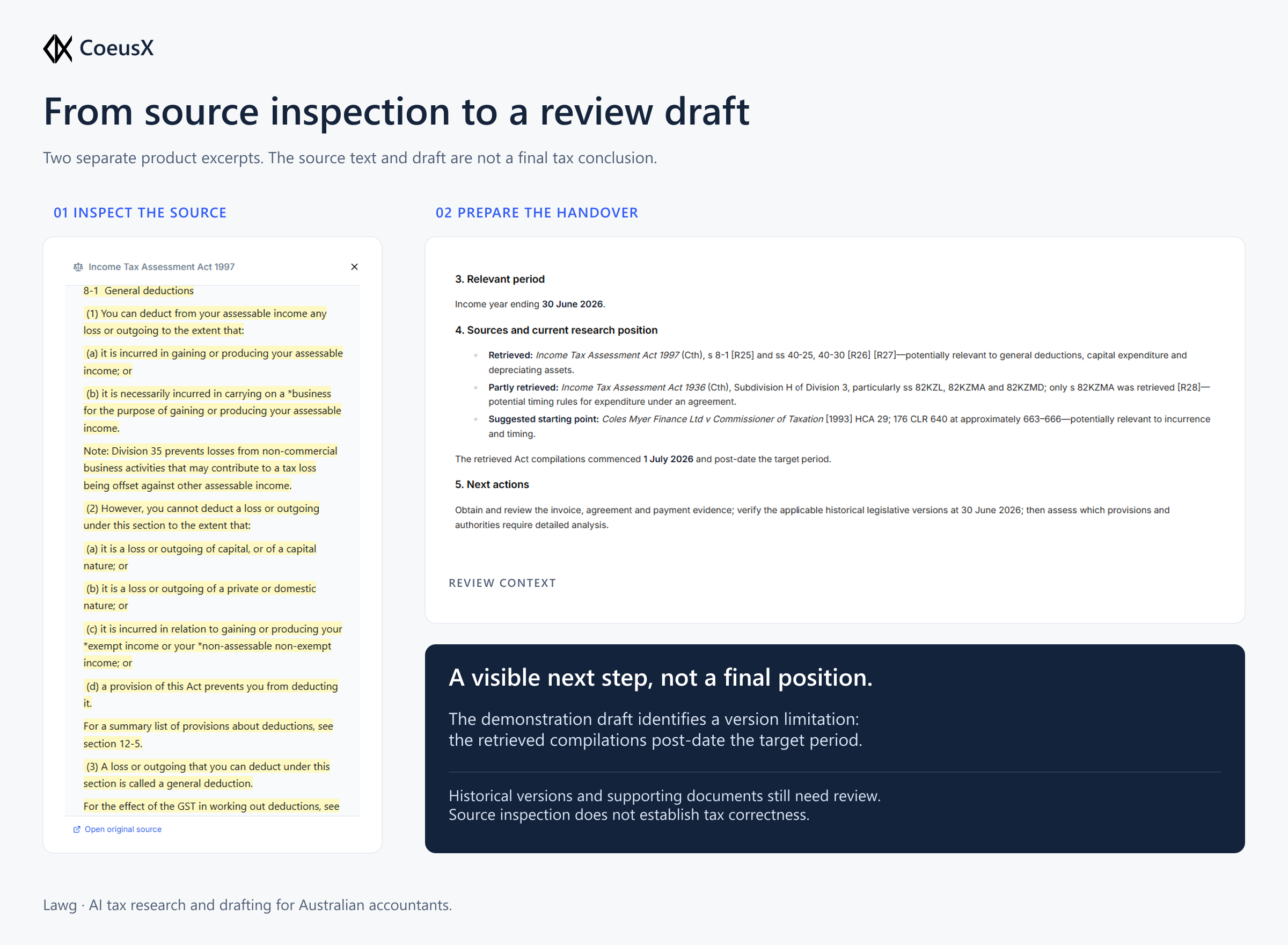
For an earlier captured workflow, see From Tax Question to Source Review in Lawg. Read Lawg’s methodology and limitations before using the output in professional work.
Short fictional handover example
The following example is entirely fictional and does not provide a tax conclusion.
| Field | Example handover record |
|---|---|
| Matter | Seabird Studio Pty Ltd — software agreement invoice |
| Research question | What facts and authorities need to be considered before the firm determines the treatment of an amount invoiced under a software agreement during the year ending 30 June 2026? |
| Confirmed facts |
|
| Assumption or missing fact | It is not yet known whether the agreement was later varied, which service period the invoiced amount relates to, or whether payment has been separately confirmed. |
| Relevant period | Year ending 30 June 2026. The research should use legislation and guidance relevant to the applicable period and the material dates confirmed during further review. |
| Research starting points |
Specific legislation, rulings or judgments have not yet been reviewed. |
| Current research position | No preliminary view has been reached because the final agreement and service period have not been confirmed. The relevant source categories have been identified, but their application depends on the missing facts. |
| Unresolved question | Was the agreement varied, what period does the invoiced amount relate to, and has payment been separately confirmed? |
| Next action and review | The engagement manager will obtain the final agreement, confirm the service dates and verify the payment status if relevant. The updated facts and source analysis will then be provided to the senior reviewer. |
Short tax research handover checklist
1. Research question and scope
- Is the exact research question stated clearly?
- Are the purpose, intended output and relevant scope recorded?
- Are exclusions and any provisional parts of the question visible?
- Is the relevant jurisdiction, regime or entity type recorded where it matters?
2. Facts, assumptions and missing information
- Are confirmed facts separated from unverified information and assumptions?
- Is the source of each material fact recorded?
- Are missing facts and material inconsistencies identified?
- Are facts kept separate from technical interpretations?
3. Relevant dates and period
- Are the material transaction or event dates recorded?
- Is the applicable income year or reporting period clear?
- Is the relevant point-in-time source version identified where needed?
- Is the date of the research or last update recorded?
4. Sources reviewed
- Are the principal authorities precisely identified?
- Are direct links and stable pinpoint references included?
- Does the handover explain what each source appears to support?
- Are material limitations, contrary sources and source status visible?
5. Current research position
- Is the preliminary view recorded, if one exists?
- Are the main facts and authorities supporting it identified?
- Is it clear what remains uncertain or requires checking?
- If no view has been reached, is the reason recorded?
6. Unanswered questions and limitations
- Are the main missing facts or research gaps stated precisely?
- Are unresolved source or interpretation issues visible?
- Are related issues outside the current scope separated?
- Is any required senior or specialist review identified?
7. Next actions and review
- Is each next action specific?
- Is an owner and required reviewer identified?
- Are relevant dates, deadlines or dependencies recorded?
- Is the current workflow status accurate and clear?
- Can the receiving colleague locate the supporting documents and continue the work?
Download the printable one-page checklist (PDF). This is a printable worksheet, not an interactive form.
A clear handover supports the next review
A clear research handover does not turn preliminary work into a final or approved position.
It gives the next authorised colleague a visible starting point: the question, factual basis, relevant period, source trail, current research position, unresolved matters and actions still required.
Published by CoeusX. To report a correction, contact CoeusX.