
An Australian tax research question can lead to more than an answer. In this Lawg example, the response surfaced information to clarify, and the captured session showed a cited source open beside the research. This CoeusX walkthrough follows that path: the brief, the questions raised, and the source view.
The example concerns purchases used partly for business and partly privately. It demonstrates a research workflow, not the GST treatment of those purchases. The product example was captured on 9 September 2026.
Start with the question and its boundaries
The session began with a specific request:
How should I research GST credits for purchases used partly for business and partly privately?
The prompt did not stop at the question. It supplied the known facts, specified an example period, and described the kind of response the user wanted.
| Part of the brief | What this example supplied |
|---|---|
| Question | Researching GST credits for mixed business and private purchases |
| Known facts | A business registered for GST in Australia, with some mixed-use purchases |
| Relevant period | The 2025–26 income year, as specified for this example |
| Requested output | Missing facts first, followed by official Australian primary sources with references to inspect |
| Boundary | No entitlement calculation and no assumptions about facts not supplied |
The 2025–26 period belongs to this captured example; it is not a label for the current financial year. A different research brief needs its own relevant dates and period.
These fields make the request explicit. They describe what the user asked Lawg to do, rather than proving that the response fulfilled every part of the request.
See what the response asks you to clarify
Under “Planned and actual mixed use”, the response raised questions about intended use, the basis for estimating it, actual use after acquisition, and changes over time.
For example, one question was:
What was the actual use after acquisition?
This is a useful part of the demonstration: the response presented questions the user could investigate, not just a finished-looking explanation. The captured questions do not establish that every relevant fact was identified or determine a GST entitlement.
Follow the research into the source view
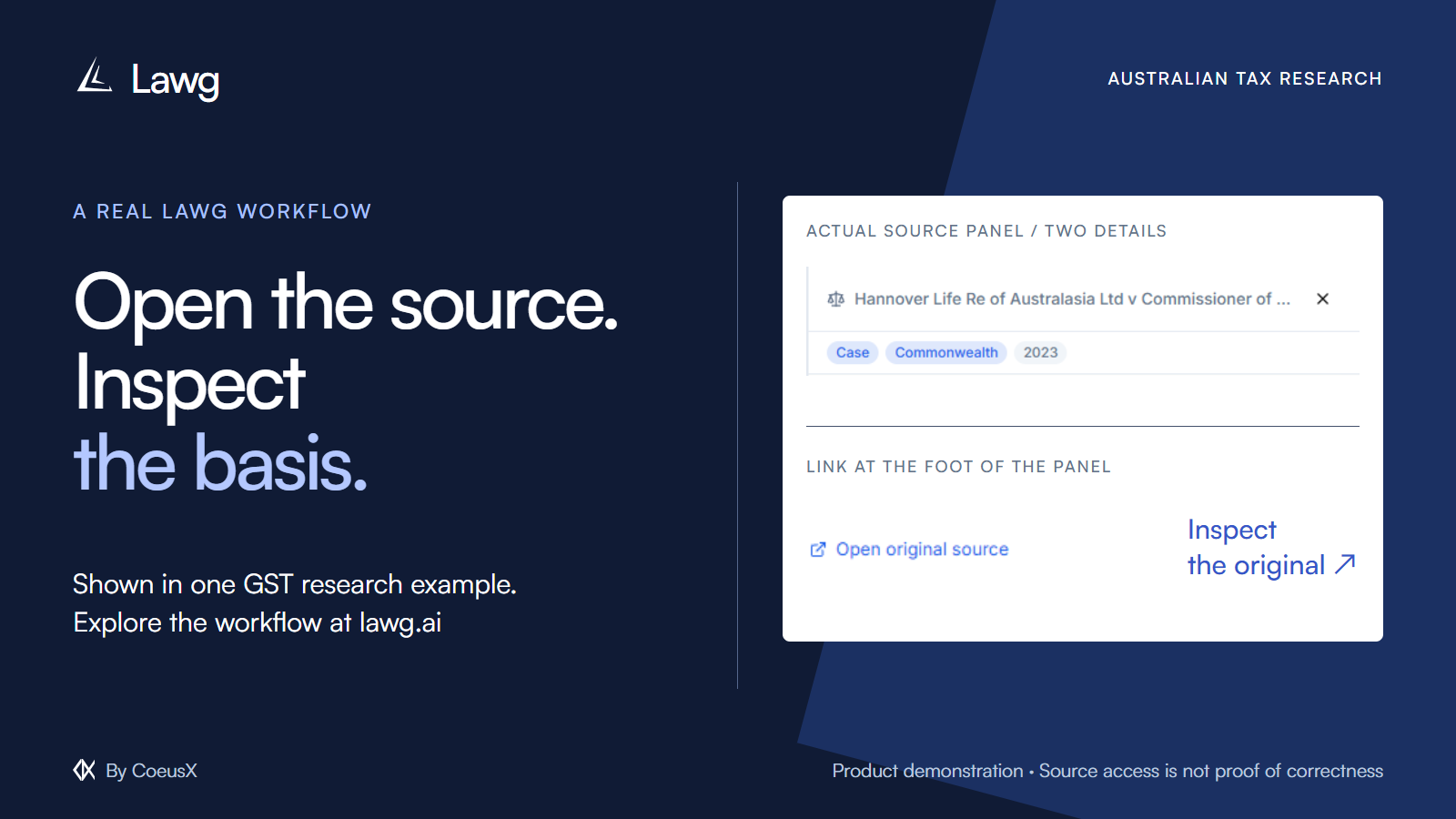
The captured session also shows a cited case open in Lawg’s side panel. Its header displays a source title, document-type label and year. At the foot of the panel is an Open original source link.
The visual accompanying this article presents the header and footer as two separate details. It does not reproduce the legal passage between them or assess the case’s relevance to the GST question.
That distinction keeps the demonstration focused on the product: a reader can see how source information is presented alongside research. The presence of a source panel is not certification that an answer is correct or that the displayed source is current or applicable.
For the broader explanation, read how source traceability supports AI tax research. This walkthrough adds a concrete captured example to that discussion.
Reuse the structure for your next research brief
Adapt this template to make the question, known facts and requested sources clear:
Help me prepare an Australian tax research brief.

Question: [The issue I want to research]
Known facts: [The relevant facts I can provide]
Relevant period: [The dates or period for this research]

First identify missing information that could affect the research.
Then list relevant official Australian primary sources with
references I can inspect.

Do not calculate an entitlement or assume facts I have not provided.
Use a demo scenario without client-identifying information when exploring the workflow. The template makes the question, context and requested sources visible before you assess the response.
Explore the workflow in Lawg
Take the same approach to your next research brief: define the question, investigate missing facts and inspect the available sources.
Read Lawg’s methodology for its research approach, or explore the workflow in Lawg.
Product demonstration only. This article does not provide tax, legal or financial advice. Available references support source review; they do not establish correctness, completeness or suitability for professional use.